
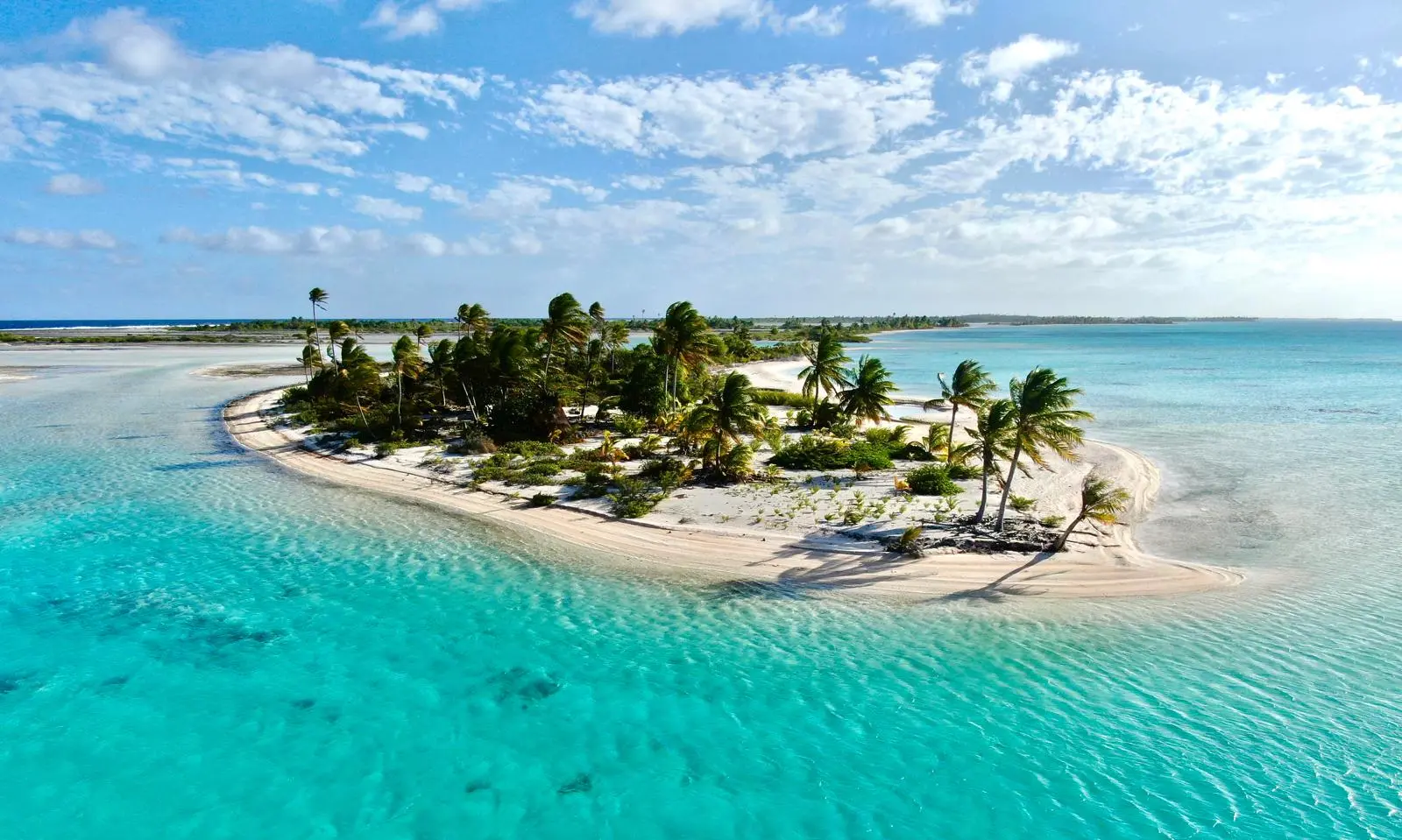
Tikehau means ‘peaceful landing’, and indeed, from the moment we sailed into this atoll, the hustle and bustle of the world disappeared. After more than ten days of stormy weather, during which it was impossible to do anything, the wind finally died down. Enough for Ralph and Jeroen to go kiteboarding and windsurfing. After that, the wind decreased further, and we could explore with the dinghy. We floated in the turquoise lagoon of Tikehau, surrounded by nothing but sea and sky. Tikehau is an atoll. When I look at it like that, I find it one of nature’s most fascinating wonders. As I sat in a hanging chair looking out over the lagoon and felt the wind gently blowing around me, I wondered: how does such a special place come into being?
The creation of an atoll
It starts millions of years ago, deep under the ocean, with a volcano rising from the ocean floor. It erupts wildly, spewing and churning, forming a volcanic island that towers above the sea. Coral begins to grow around this volcano. This vibrant reef feeds on the minerals in the warm, shallow waters surrounding the island. Over thousands of years, the coral swells and slowly builds its colourful walls, attracting countless marine life.
At some point, the volcano stops erupting, and the island slowly begins to sink. But the coral continues to grow steadily upwards toward the sunlight. The reef follows the contours of the sinking island, and when the volcanic island finally disappears entirely beneath the sea, a circular ring of coral remains. This ring encloses a shallow lagoon, the heart of the atoll.
Now, millions of years later, the volcanic island has disappeared deep beneath the ocean, and what was once a barren landscape of lava is now a paradise of white coral sand beaches, palm trees, and crystal clear water. Nature has created her own masterpiece, with the coral reef as the silent builder of this fragile but impressive structure.
The many motus of Tikehau
Within an atoll are often smaller islands known as motus. A motu is a small, flat island formed from sand and coral rubble that accumulates on the edge of the coral reef. In Tikehau, numerous motus are scattered along the outer edge of the lagoon. These islands not only provide a beautiful backdrop but are also essential to the biodiversity of the atoll. Some motus have dense forests of palm trees and other vegetation, adding to the atoll’s charm.
The giants of the Motus
Another frequently asked question is: how do all those palm trees end up on Motus? The answer lies in the power of the sea and the coconut, the fruit of the coconut palm. Coconuts can float and are carried over enormous distances by ocean currents. When they wash up on the beaches of a motu and conditions are right, they begin to germinate. From that one washed-up coconut, a coconut palm grows, which quickly takes up a permanent place on the island.
Palm trees are well-adapted to the salty, coastal environment of atolls. Their roots penetrate deep into the sandy soil to reach the fresh groundwater hidden beneath the surface.
Hidden freshwater sources
But how can there be freshwater on an atoll surrounded by salty seas? Atolls are made of porous coral and limestone, which allows rainwater to seep through the soil. Because freshwater is lighter than saltwater, the fresh rainwater remains above the salty seawater in a lens-shaped layer. This forms a hidden freshwater source underground, which is essential for both the vegetation and any human inhabitants of the atoll.
This freshwater lens is often fragile, as the amount depends on rainfall and the size of the atoll. But it is sufficient for palm trees and other plants to survive. The freshwater that reaches the roots ensures that even these small, remote islands can have a thriving ecosystem.
Tikehau, with its vast lagoon and countless motus of swaying palm trees, is the result of centuries of natural evolution. As we kayak and paddleboard through the lagoon, surrounded by the pristine nature of this unique ecosystem, it’s hard to imagine that everything you see began with the raging heart of a volcano, now sunk deep beneath the ocean waves.
Tuherahera
Together with Ralph van Lille Venn, we explore the village of Tuherahera, home to 95% of the atoll’s 540 inhabitants, making it the main village. As soon as we enter one of the main streets, we are enveloped in the sweet scent of the tiare flower, which grows in abundance here. The tiare flower is more than just a plant; it is a symbol of French Polynesian culture and lifestyle. Both men and women wear this flower behind their ear, and the side on which it is worn subtly indicates the wearer’s relationship status. If you wear the flower behind your right ear, you are single; behind your left ear, you are taken.
The Tiare plays an important role in daily life and is also used in traditional ceremonies, as decoration and in the making of perfumes and oils. The flower symbolizes hospitality and purity.
In the village, we discover two small supermarkets, a bakery where you can order fresh bread at the end of the afternoon, a pizzeria and a cosy lunch café. The pizzeria is only open on Friday and Saturday, so we decided to eat there on Friday. For now, we enjoy a hamburger at the lunch café while we take in the quiet atmosphere of Tuherahera.
Cleaning station for Manta Rays
A few times, we sail with the dinghy to a motu in the middle of the atoll, where an old pearl farm is located. At this location, there is a “cleaning station” for manta rays, which are cleaned of parasites by small fish. In addition to the manta rays, we also see numerous blacktip reef sharks and colourful coral fish.
In search of undiscovered areas
On a sunny day we decide to sail further into the atoll, with Jeroen in front of the point to point out all the “bommies” (coral pillars). We are in an undocumented part of the atoll, so it is important to pay close attention. Once we arrive at our new location, where we are anchored together with Ralph van Lille Venn, we enjoy adventurous trips with the kayak and paddleboards.
The Garden of Eden of Tikehau
We have been here for almost three weeks now, and our fresh supplies are almost empty. The local supermarkets did not seem to have any fresh vegetables or fruit available. The neighbouring atoll of Rangiroa has larger supermarkets, and we briefly considered sailing there. But then we hear a rumour that piques our curiosity: further into the atoll, deeply hidden, lies a small community that has been growing vegetables and fruit for thirty years. In the middle of this inhospitable environment, they have created a green oasis. “What on earth can you grow here?” I wonder out loud.
It almost sounds too good to be true: the Garden of Eden, hidden in the heart of Tikehau. The temptation is too great to resist. We decide to raise our anchor and make the nine-mile journey further into the lagoon. What will we find there? Is this hidden paradise real, or just a story lost in the waves of the lagoon? The only way to find out is to sail into the unknown. You can read more about this next time.
MESSAGES ON BOARD
Leave a message
Share a thought, question or greeting. Aagje reads every comment before it appears here.
Loading comments…