
For the past few weeks, our lives have revolved around weather charts, satellite images, and forecasts. Every morning starts the same way. While the coffee slowly brews, we open PredictWind, study the latest models, and once again hope to find that small weather window we have been searching for for weeks.
Ever since we arrived in the Yasawa Islands, everything has revolved around one plan: making the passage to the Lau Group.
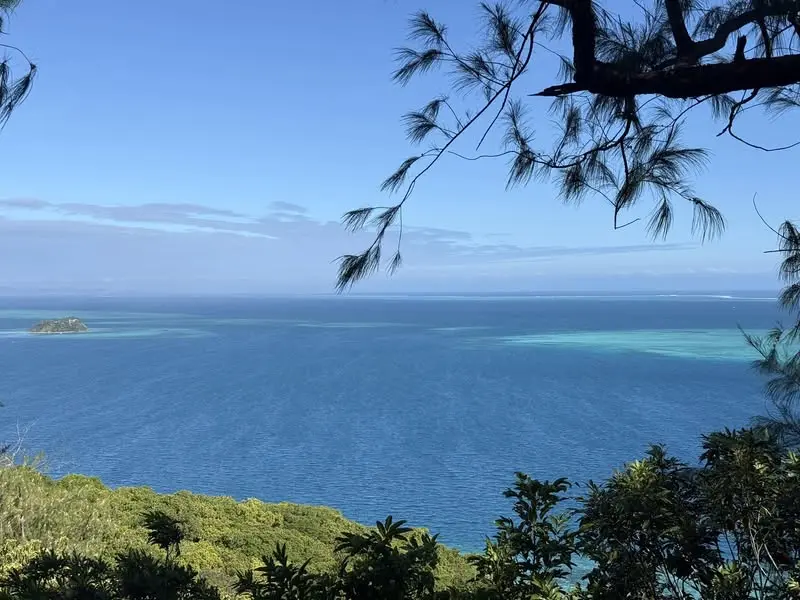
Many people travel to Fiji specifically to visit the Yasawa Islands. A long chain of volcanic islands that were pushed up from the ocean millions of years ago by immense forces deep beneath the earth’s crust. Steep green mountains rise straight out of brilliant blue water, white sandy beaches are tucked away between sheltered bays, and vibrant coral reefs surround the islands. It is rugged, raw, and breathtaking all at once.
Yet the longer we stay here, the more strongly we feel that Fiji is far bigger than this northwestern corner of the country. The longer we remain, the more often our thoughts drift toward the islands hundreds of nautical miles to the southeast. Toward the place that almost every sailor who has ever visited speaks about with sparkling eyes.
The Lau Group.
Scattered across a vast area are dozens of remote islands, lagoons, and villages where life is still largely shaped by tradition, fishing, and community. Many of these islands receive only a handful of visiting yachts each year. That is precisely what makes them so special. Fewer resorts. Less tourism. More of the Fiji that once was.
But Fiji does not give the Lau Group away easily.
Under normal circumstances, the wind here blows from the east almost all the time. These are the famous trade winds that define the weather patterns of the entire region. For many sailors, these winds are ideal. For us, however, they create a problem. To sail from the Yasawas to the Lau Group, we need exactly the opposite: a temporary shift to westerly winds so we can make a safer and more comfortable passage to the southeast. And that almost never happens.
Instead, one weather system after another passes above and below Fiji. For more than five weeks, the islands have been battered by strong easterly winds that regularly exceed thirty-five knots, coming directly from the direction we need to travel. Beating into those conditions through reefs, shoals, and open ocean is not only uncomfortable, it is simply unwise. So we do what every sailor eventually learns to do. Wait.
Meanwhile, Jeroen comes down with the flu. Fortunately, he recovers after a few days. Not long afterward, it is my turn. And not mildly either. Fever, a cold, persistent coughing, and a body that feels as though it has been left behind somewhere along the way. For days, the weather forecasts and our health seem to compete over who can keep us grounded the longest.
Still, we keep hoping. Because sooner or later that weather window will appear. And then, almost unexpectedly, it does. Not perfect. Not ideal. But better than anything we have seen during the previous five weeks.
So we raise the anchor.
The first part of the journey unfolds exactly as expected. Wind and waves straight on the bow. Not extreme, but certainly not comfortable. As we move beyond the shelter of the islands, the wind gradually decreases to around thirteen knots and later in the day almost disappears entirely.
When we look around, all we see is water. Endless stretches of blue reaching all the way to the horizon. Almost peaceful. But that is exactly what makes this part of Fiji so deceptive. Beneath that calm surface lies an almost invisible maze of reefs, coral banks, and shoals. Some reefs lie only inches below the surface, while others rise suddenly from deep water.
Among cruising sailors, Fiji has a reputation for demanding constant vigilance. Many sailors say they have never spent as much time on lookout anywhere else in the Pacific. Whether more boats actually hit reefs here than elsewhere is difficult to say, but the number of grounding stories is certainly remarkable. With hundreds of islands, thousands of reef systems, and charts that do not always perfectly match reality, navigating Fiji remains a discipline of its own.
Although charts are far better today than they were in the past, we never rely on a single source. Satellite imagery is just as important. We constantly switch between charts, depth information, and aerial imagery to ensure there is not a reef sitting slightly differently than shown on the chart.
Fiji forces you to stay alert.
When the headwinds persist longer than forecast, we decide to anchor for the night and follow the northern route inside the reef system. Not a spectacular decision, perhaps, but certainly the wisest one.
Once at anchor, we receive a message from Barbara asking whether we would like steak from the barbecue, accompanied by a fresh salad. That is not exactly a difficult question.
Before long, we are aboard Lille Venn.
While preparations for dinner are underway, we suddenly hear the buzz of a drone overhead. Laughing, we look up. Apparently, someone has found a new hobby. At least, that is what we think. Barely a few minutes later, a boat comes alongside.
Customs. Five officers.
Dinner is temporarily put on hold while the officers come aboard for an inspection. The first thing that strikes us is how friendly the entire process is. Before stepping aboard, they explain that they will remove their safety boots to avoid dirtying the boat, something we honestly have never experienced during an inspection before.
Documents are checked, questions are asked, and compartments are inspected. It is not only Lille Venn that receives a visit.
My Motu is inspected as well. Jeroen returns to our boat with the officers, where documents are reviewed once again, lockers are opened, and a brief inspection is carried out.
Everything is professional, friendly, and relaxed. When it becomes clear that everything is in order, we thank each other, and just as quickly as it arrived, the interruption is over. And finally, we can enjoy our steak, slightly less hot than intended but still absolutely delicious.
The following morning, there is almost no wind at all. So we continue under motor.
After about eight hours, we reach a well-known anchorage near a resort where we can briefly go ashore. The next morning, we take a taxi to Rakiraki to stock up on groceries, fresh fruit and vegetables, and refill our diesel supply. After taking care of the practical necessities, we decide to treat ourselves to lunch at the resort.
A decision that later provides more laughter than satisfaction.
The food turns out to be thoroughly disappointing.
Only afterward do we learn that the resort is not yet fully operational because the season does not officially begin for another few weeks. An explanation that may be understandable, but one we would have preferred hearing before rather than after staring at our plates.
The next morning, we set off once again. At first under motor, but gradually the reefs disappear behind us and we find ourselves back in deeper, more open water. The feeling changes immediately. Less staring at subtle color changes in the water. Less constant chart checking. More space. More ocean and dolphins.
By late afternoon, we drop anchor at Makogai Island.
Because sevusevu is required here, we soon climb into the dinghy dressed in our sulus, carrying a bundle of kava under one arm, and head toward the village. It would be impolite to simply anchor and perhaps leave again the next morning without first introducing ourselves to the community and the chief.
Beneath a large mango tree, the chief and several villagers welcome us warmly. What begins as a brief introduction quickly grows into an afternoon filled with stories. The chief turns out to be a natural storyteller.
Before long, he takes us back through the history of Makogai, an island that has lived many different lives.
According to stories still passed down through the community, a German trader named William Hennings arrived on the island during the colonial era. Hennings was one of the most influential European traders in Fiji at the time. The chief explains that local tradition tells of Hennings bringing weapons and ammunition to the islands and receiving land on Makogai in return. Whether events unfolded exactly that way is impossible to verify today, but more than a century later, his name is still remembered here.
In the years that followed, increasing amounts of land came under foreign ownership. According to local accounts, large portions of the island eventually became controlled by only a few European families. For the original inhabitants, this meant multiple relocations and repeated attempts to rebuild their lives elsewhere.
Later, Makogai would be given an entirely different purpose.
In 1911, the colonial government established a leprosy settlement on the island to serve the Pacific region. People from Fiji, Tonga, Samoa, and many other islands were brought here to live in isolation. Families were separated, and many never saw their homes again. The settlement remained active until the late 1960s, when effective treatments for leprosy became available and the need for isolation gradually disappeared.
When the leprosy settlement finally closed, Makogai once again faced the question of what its future would be.
This is where the chief’s own story begins.
With visible enthusiasm, he describes how he became involved in an ambitious agricultural project intended to give the island a new purpose. His idea was to develop a breed of sheep capable of thriving in Fiji’s warm, humid climate. Sheep from Australia, New Zealand, and the Caribbean island of Barbados were brought to Makogai and crossbred. Eventually, a new meat sheep breed was developed that adapted exceptionally well to tropical conditions.
As he speaks, his pride remains unmistakable. This is not simply history to him. He helped create it. But eventually, that chapter also came to an end.
Today, Makogai serves yet another purpose.
Part of the island is now managed by the Fijian government and used for marine research and conservation. At the Makogai Mariculture Centre, giant clams are bred and raised, species that once flourished throughout Fiji’s reefs. When they reach sufficient size, they are transplanted to reefs around the country, helping restore fragile marine ecosystems.
The contrast is remarkable.
On the same island where patients from across the Pacific once lived in isolation, marine biologists and researchers now work to protect the ocean. Where sheep once grazed the hillsides, young giant clams are now carefully nurtured before being returned to the reefs.
As the chief finishes his story, we realize just how extraordinary Makogai truly is.
Behind the green hills and tranquil bays lies a history of colonial traders, forced relocations, disease, agricultural experimentation, and ultimately environmental restoration.
The island has reinvented itself more than once. Perhaps that is exactly what makes Makogai so special. As we listen, I am reminded once again of what makes travelling by sailboat so extraordinary. Not only the places you visit. But the people you meet.The stories you hear. The history that never appears in guidebooks yet lives on in the memories of those who call these places home.
Later, as we make our way back to My Motu, the sky slowly begins to darken.
In the distance, thunderclouds are building along the horizon.
At that moment, we have no idea that those clouds will mark the beginning of a passage that will ultimately prove far more challenging than we ever expected.
But that is a story for the next blog.
MESSAGES ON BOARD
Leave a message
Share a thought, question or greeting. Aagje reads every comment before it appears here.
Loading comments…