
In Makogai Bay, the world seemed to consist of nothing more than water, rain, and grey skies that day. From the shelter of our cockpit, we looked out over a horizon that had almost completely disappeared behind a curtain of pouring rain. The hills of the island were little more than faint shadows in the distance, occasionally emerging from the gloom before being swallowed once again by the next rain shower sweeping across the water.
The wind blew relentlessly across the anchorage, chasing small whitecaps over the surface. My Motu lay safely at anchor, but tugged restlessly on her chain as gusts raced across the bay. The sound of rain hammering on the deck drowned out almost everything else. At times it seemed as if thousands of tiny fingers were tapping on the boat at once, only to transform moments later into a deafening roar when another squall opened up above us.
Yet there was something special about the landscape. The colours had been reduced to only a handful of shades: the dark grey of the clouds, the silvery water, and the soft green of the island trying to remain visible through the rain. This was not the tropical Fiji of postcards and turquoise lagoons, but a rougher, more honest side of the islands. A side that reminds you how small you can feel at sea when nature decides to take complete control.
As the rain continued to fall and the wind whistled through the rigging, time seemed to stand still. There was nothing to plan, nowhere to rush to, and nowhere to go. There was only waiting. Waiting for a change in the sky, for a break in the weather, for that one moment when the ocean decided it was time to move on.
And it is during those hours that you are reminded once again of one of sailing’s most important lessons: the sea cannot be forced. Sometimes the greatest achievement is not covering miles, but simply waiting patiently until nature allows you to continue.
We kept in touch with Barbara and Ralph through messages. Like us, they were safely anchored and looking out over the same grey world of rain, wind, and low clouds. It quickly became clear that nobody was seriously considering sailing on that day. Of course, we all checked the weather charts regularly, compared forecasts, and searched for that small weather window every sailor hopes for, but deep down we already knew what the wisest decision would be. Sometimes you simply have to accept that the ocean is not willing to cooperate.
Once that decision had been made, a certain calm settled over the boat. The pressure to leave disappeared and suddenly there was nothing that needed to be done. No route planning, no calculating arrival times, no constantly scanning the horizon to see whether conditions might improve after all.
For me, a day like this usually means pulling out my laptop. While the rain continues its endless drumming on the deck and the wind occasionally sends another gust sweeping across the bay, I retreat inside with a cup of tea and settle at the saloon table. Often I continue working on a new blog, trying to capture the adventures of the past few days while the memories are still fresh. At other times, I disappear into the colourful underwater world of Dot, the little blue fish with three dots on her side from the children’s book I have been writing along the way and which has gradually taken on a life of its own. I can spend hours inventing stories about encounters with whales, manta rays, and other ocean creatures while, outside, the real ocean sloshes against the hull.
Meanwhile, Jeroen is rarely someone who sits still for long. While I write, he usually makes his rounds through the boat, checking whether everything is still functioning as it should. On a sailboat there is always something that deserves attention. A battery check, a look at the solar charging system, an inspection of a pump, or a piece of equipment that sounds ever so slightly different than usual. Sometimes he actually finds something that needs fixing, but more often than not his inspections end with the reassuring conclusion that everything is working exactly as it should. Still, it clearly gives him satisfaction. A well-maintained boat inspires confidence for the next leg of the journey.
Outside, however, the rain shows no intention of stopping. Hour after hour, new squalls sweep across Makogai. Occasionally we think it is getting lighter, only to see another dark band of clouds appear on the horizon and once again drape the bay in shades of grey. By the time lunch is over and the rain is still falling with the same determination as it did that morning, we look at each other and decide it is time for something different.
We settle into the saloon, put on a movie, and leave the outside world to its own devices for a while. As the wind whistles through the rigging and raindrops drum rhythmically against the windows, we relax and watch the screen. These may not be the adventures people imagine when they dream of life aboard a tropical sailboat, but they are just as much a part of it. Days when you do not sail, snorkel, or discover new islands, but simply shelter from the weather, enjoy each other’s company, and wait for the ocean to decide that it is time to move on.
Around three o’clock in the afternoon, something happens that we had almost stopped expecting. After a day of rain, heavy clouds, and strong winds, the sky slowly begins to clear. First, a small patch of blue appears above the hills of Makogai. Then the last raindrops disappear, and before long even the sun cautiously makes an appearance. It feels as though someone has suddenly pulled back a curtain and returned colour to the world.
Not long afterwards, Jeroen receives a message from Ralph asking whether he would like to come along and inspect the western pass. If it turns out to be navigable, we can avoid a large section of reef navigation and head almost directly into the open ocean. By now, Fiji has taught us that charts do not always tell the truth, so a firsthand inspection is far from a luxury.
Ralph picks Jeroen up in the dinghy and while they head towards the pass, I remain aboard. From My Motu I watch the sky continue to brighten. About forty-five minutes later I see the dinghy returning. The pass is exactly where the chart says it should be and, more importantly, it is wide enough to be used safely.
Jeroen and Ralph come to collect me and we head over to Lille Venn, where Barbara has baked fresh muffins. While the weather outside continues to improve, we sit around the table with a cup of coffee and discuss what they have seen. The charts come out once again, along with the weather forecasts we have already studied several times that morning. On the screen we can see that the enormous rain and thunderstorm cell that had seemed destined to pass directly over us has moved further north. The threatening black mass that had dominated our attention for hours appears willing to leave us in peace.
Slowly, the atmosphere around the table begins to change. Only a few hours earlier we had all been convinced we would stay put, but now a different scenario is cautiously being discussed. If we leave, we need to leave now. Wait much longer and we will have to pass through the western pass in darkness, something none of us finds appealing. On top of that, the westerly wind would help carry us towards Fulaga, the island located at the southeastern tip of the Lau Group.
As the others discuss the options, I can feel my mind trying to keep up with how quickly the situation is changing. Sudden changes like this have never been particularly easy for me. For hours I had mentally prepared myself to stay put, enjoy a quiet evening aboard, and perhaps watch another movie while the rain tapped against the windows. Then suddenly an entirely different plan is on the table. Not leaving tomorrow, but today. Not another night at anchor, but straight out into the ocean.
At moments like these, my mind sometimes freezes for a second. Not because I do not want to go, but because everything happens so quickly. While my brain is still weighing the pros and cons, the decision has effectively already been made. Looking back, I usually understand perfectly well why it was the right choice, but in the moment it often feels as though events are moving faster than my thoughts can keep up with.
Before I have truly adjusted to the idea, both boats are already preparing for departure. Anchors are raised, gear is stowed away, engines are started. The relaxed atmosphere of a rainy afternoon gives way within minutes to the familiar energy that comes with an unexpected departure.
A little later, we head towards the western pass, one behind the other.
Then I notice something strange on the AIS screen.
Lille Venn turns around.
At first, I think I must be seeing things, but it quickly becomes clear that they are indeed turning back towards the bay. I barely have time to think about it. The sea demands all of my attention and I am focused on keeping My Motu on course as her bow repeatedly drives into the next wave.
Then a message from Barbara appears.
Something has broken on the mainsail. Immediately, I feel a knot form in my stomach. Not only because breakdowns never happen at a convenient moment, but also because it is getting darker by the minute. Ralph will have to climb the mast to fix the problem before they can continue their journey. As I watch the waves rolling beneath us, I try to imagine what it must be like to climb a mast in these conditions.
For quite some time, Lille Venn continues sailing back and forth in front of the pass. On the AIS screen, I can see their track moving up and down while Ralph works to solve the problem. Eventually, they turn once more towards the passage and disappear to the ocean side of the reef.
Meanwhile, we continue on our way, but my eyes keep returning to the screen. You try to focus on your own boat, on the course, the wind, and the sea, yet that nagging feeling remains. Because at sea you know how quickly an ordinary departure day can turn into a situation nobody would have imagined just an hour earlier.
As the sun slowly disappears below the horizon and the last orange colours fade from the sky, a very different battle begins for me. The seasickness arrives almost immediately. The sky is completely overcast, with not a single star or moon visible. Outside, the world consists of nothing but darkness, black waves, and the occasional flash of white foam when a wave breaks. The absence of a horizon only makes things worse. My eyes constantly search for a fixed point, but find nothing.
We are sailing hard on the wind and the boat makes sharp, restless movements. The waves build to around three metres, but it is not even their height that makes it difficult. It is the short interval between them. Sometimes there are barely two seconds between wave crests, giving My Motu no chance to recover. She climbs one wave, crashes into the trough behind it, immediately climbs again, only to be stopped almost at once by the next wall of water. Regularly, large waves break over the foredeck and torrents of water rush noisily along the side decks towards the stern.
Yet we are making progress. Slowly, painfully, and nowhere near as fast as we had hoped, but at least we are moving in the right direction.
Around one o’clock in the morning, Jeroen is on watch. I have only just managed to doze off when he wakes me up. Half asleep, I climb into the cockpit and look at the screen.
Fiji, once again, has other plans for us.
During the night, the wind has shifted much further east than forecast. Our carefully calculated course becomes less favourable with every passing hour. Slowly but surely, we are forced further south. On the AIS we can see that Lille Venn is doing exactly the same thing.
We exchange a few messages and Ralph lets us know that they are heading for shelter behind Moala Island. By now, they are suffering from seasickness as well and feel it is time to get some rest. The wind continues to increase, hovering around thirty knots. There seems to be no end to the pounding, the rolling, and the constant roar of breaking water.
More than once, I find myself thinking about Barbara and Ralph. I know how uncomfortable Lille Venn becomes once the waves exceed two metres. People often praise the comfort of catamarans, but in this short, steep sea I am secretly grateful that My Motu is a heavy monohull. She may move violently, but her movements feel predictable. Familiar, even.
Meanwhile, the queasy feeling in my stomach stubbornly refuses to leave. The blue bucket beside me is my most faithful companion at that moment. Only when I occasionally catch sight of a small piece of horizon between the waves does the nausea begin to ease.
Around one o’clock in the afternoon, we finally reach the shelter of Moala Island. By then, both boats have spent more than twelve hours battling strong winds and steep ocean waves. Almost immediately, we notice the difference. Outside the island, the ocean continues to rage, but behind the high landmass the largest waves disappear as if someone has flipped a switch.
Unfortunately, anchoring is not an option, nor is there a pass we can enter. The seabed drops away too quickly and we cannot find a suitable anchorage anywhere. At first, we decide to sail slowly back and forth behind the island under a small amount of sail, while Lille Venn simply switches off the engine and begins drifting.
We have never done that before.
Curiously, we watch their boat moving peacefully with the wind and current. After some discussion, we decide to try the same thing. Not long afterwards, we shut down the engine as well and allow My Motu to drift freely behind the island.
It feels strange. After hours spent steering, correcting course, avoiding waves, and trying to keep the seasickness under control, we suddenly do absolutely nothing. For the first time in nearly twenty-four hours, I feel my body relax. Only then do I realise how exhausted I have become. The tension that had quietly built up throughout the long night at sea slowly begins to fade. My shoulders relax, my stomach settles somewhat, and the constant state of alertness gives way to something that feels remarkably like relief.
For five hours, we drift in the lee of the island while the ocean continues raging outside. The contrast between shelter and open sea feels almost unreal. We sleep a little, sip water carefully, try to eat something, and slowly begin to recover.
Only Jeroen seems completely unaffected. While the rest of us turn various shades of green from seasickness, he moves around the boat as if it were an ordinary working day. Thanks to that, I am able to get some extra sleep, something my body clearly needed more than I realised.
When we decide to leave again around six o’clock in the evening and have almost sailed past the island, we notice the first flashes of lightning in the distance. On the horizon, another dark thunderstorm cell is building, while at the same time the wind begins increasing once more towards thirty knots.
It feels as though the ocean wants to test us one more time.
We look at the dark mass of clouds building ahead of us, then at each other, and instantly know the answer. Without any discussion, we turn around. Sometimes good seamanship is not about courage but about patience. Sometimes turning back is not a sign of weakness, but simply the wisest decision you can make.
We send a message to Barbara and Ralph, who are still sailing behind us. Their reply comes quickly. They are visibly relieved that they can turn around as well and get a few more hours of sleep before we make another attempt.
Finally, around half past midnight, the wind eases enough for us to continue. Carefully, we set course once more. Originally, we had planned to seek shelter behind another island where we might have been able to anchor, but then something happens that nobody expected.
The wind shifts. Not a little. Not just enough. But exactly the right way. We seize the opportunity immediately and set a direct course for Fulaga. For six hours, we sail beneath a sky full of stars while the sea gradually calms down. Then the wind dies completely. The sails hang limp against the masts, the water turns into a dark mirror, and eventually we start the engine. We are no longer in a hurry. Fulaga is too far away to reach before dark and, since Fulaga has a very narrow and unfamiliar pass, we will only enter it in daylight.
So we continue through the night at three to four knots, while the island lies somewhere far ahead, hidden in the darkness, waiting for us to finally arrive.
About twenty-five miles from Fulaga, our paths temporarily part ways. Barbara and Ralph decide to take things a little easier and drop the anchor so they can get a few hours of sleep before continuing. After the two days we have just endured, it is more than an understandable decision. Fatigue accumulates, concentration becomes a precious commodity, and nobody gains anything by entering a reef passage completely exhausted.
We decide to do something different.
Slowly, we motor on towards Fulaga. By now, the sea has become almost flat and the tension of the past few days seems to fade a little further behind us with every mile. Around midnight, we arrive off the island. About one and a half miles from the pass, we switch off the engine and simply let My Motu drift on the open ocean.
No sound of an engine. No flapping sails. No hurry. Just the ocean.
Looking back, it turns out to be one of the most beautiful moments of our entire journey to the Lau Group.
Fulaga lies on the horizon as a dark silhouette beneath a sky filled with stars. We have absolutely no desire to enter an unfamiliar reef passage in darkness. After everything Fiji has taught us over the past few weeks, we know that patience is often the wisest choice. So we allow the boat to drift quietly with the wind and current while the island patiently waits for the arrival of a new day.
Around half past three, I take over the watch from Jeroen. While he disappears into his bunk, I settle into the cockpit with a blanket wrapped around my shoulders. Above me stretches the kind of star-filled sky you only see in the middle of the ocean. Thousands of stars shine so brightly that it almost feels as if you could reach out and touch them.
What follows is difficult to put into words.
Shooting stars regularly streak across the sky. Beneath the boat, something strange is happening as well. The depth sounder constantly jumps from infinite depth to five metres, four metres, sometimes even three metres, before returning to nothing at all. Perhaps a large fish is swimming beneath the boat, or maybe a school of smaller fish has gathered under the hull. We will never know for certain, but that mystery is part of what makes the moment so special. Out here, in the middle of the ocean, small moments like these remind you that an entire world exists beneath the surface, one we barely know.
Slowly, the hours pass.
Throughout the night, we see no one. Not a single boat. No light pollution. No ringing phones. Only the gentle rocking of the boat on the ocean swell and the occasional light breeze brushing against my face. Nothing more. Just the stars above us and the dark water below.
Sometimes it is precisely the moments when nothing happens at all that stay with you the longest.
Only two days earlier, we had been fighting strong winds, steep waves, seasickness, and thunderstorm cells rising from the horizon like dark mountains. Back then, the ocean had felt wild, restless, and unpredictable.
Now, that same ocean seems to hold us gently in its arms.
As if it is saying:
You made it.
Welcome.
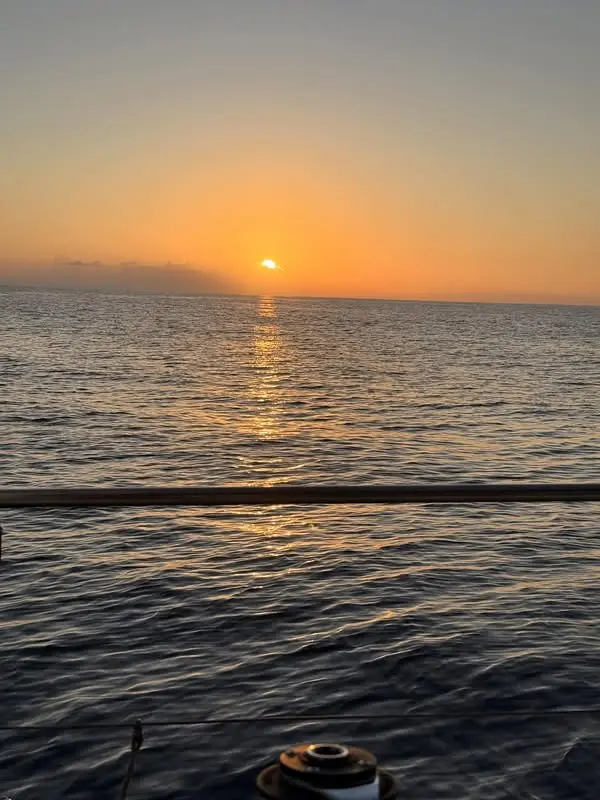
Around half past five, a faint line of light slowly appears on the eastern horizon. Night gives way to morning and, little by little, the outline of Fulaga becomes visible. Since there is absolutely no reason to hurry, I let Jeroen sleep a little longer. Meanwhile, the sun slowly rises above the horizon, painting the sky first deep orange, then soft pink, and finally a brilliant blue.
We make coffee. Enjoy a relaxed breakfast in the cockpit. And savour something we have had very little of over the past few days. Complete relaxation. Only after that do we start the engine.
Slowly, we make our way towards the narrow entrance of Fulaga. Even now, we remain alert. Fiji has taught us that paradise can still hide reefs, shallows, and surprises. But as soon as we enter the pass and leave the reef behind us, the last traces of tension disappear.
We look at each other and break into wide smiles. Words simply are not enough.
Around us unfolds a landscape that seems almost impossible to be real. The water changes from deep ocean blue to a shade of turquoise that normally belongs only on postcards. Dozens of small limestone islands rise from the lagoon, surrounded by white beaches and water so clear that the coral is visible from the boat.
It is the kind of place you see in photographs for years and secretly assume reality could never be quite that beautiful.
And yet it is.
Perhaps even more beautiful. But what touches us most is not the view itself. It is the feeling that comes with it.
After days of planning, waiting for weather windows, postponing departures, battling seasickness, fighting headwinds, thunderstorms, and exhaustion, we finally feel something we had almost lost along the way:
Peace.
Not the peace of a sheltered anchorage or a calm sea, but the peace that comes when you realise that every piece of the puzzle has finally fallen into place.
For now, we simply sit in the cockpit, looking out over a lagoon that seems almost too beautiful to be real. As the water sparkles around us in every shade of blue and green imaginable, we realise that every hour of headwinds, every sleepless night, every doubt, and every detour has brought us exactly here.
Our adventure in the Lau Group has finally begun.
MESSAGES ON BOARD
Leave a message
Share a thought, question or greeting. Aagje reads every comment before it appears here.
Loading comments…