
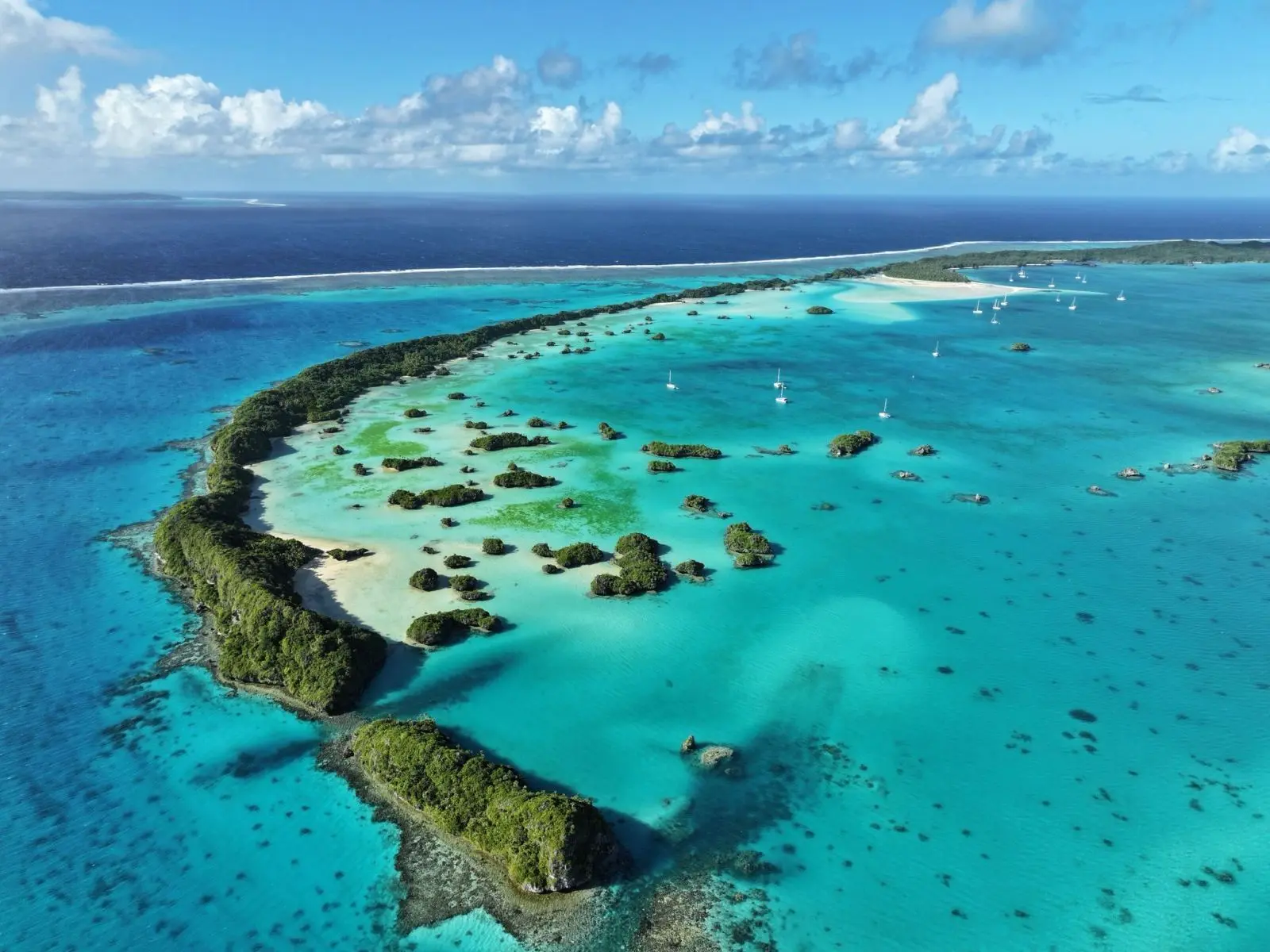
During our first few hours in Fulaga, we hardly do anything at all… and that is exactly what makes it feel like such a luxury. We sit in the cockpit with a cup of coffee, watching the sunlight dance across the turquoise water as the fatigue of the past days slowly melts away. After everything the ocean has thrown at us during the passage, it feels wonderful not to have to go anywhere for a while. After lunch, we lower the dinghy and set off to explore this paradise up close.
Our first stop is the beach for a walk. Because it is low tide, large sandbanks have emerged, stretching like pale ribbons through the lagoon. Sharp coral is scattered everywhere, so we keep our reef shoes on as we walk through the warm, crystal-clear water towards the natural swimming pools. Around us, countless shades of blue and green shimmer in the sunlight, so vivid and intense that they almost seem unreal. Time appears to slow down here, while the effort of the crossing gradually fades into the background.
A little later, we climb back into the dinghy and head towards the pass for a snorkel. The moment we slip beneath the surface, the underwater world exceeds all our expectations. Everywhere we look there is colourful coral, schools of tropical fish and fascinating formations hiding behind every section of reef. A strong incoming current carries us effortlessly along, so we barely have to swim. It feels as though the ocean itself is giving us a guided tour through its hidden world. As we drift among all this marine life, we regularly look at each other in amazement. If this is only our first afternoon in Fulaga, then the weeks ahead promise to be unforgettable.
Back on board, we enjoy a refreshing shower before checking NoForeignLand, where we see that both Lille Venn and Flora are approaching the entrance of the pass. About forty-five minutes later, they have dropped anchor, and suddenly everything feels complete again. We immediately jump into the dinghy to say hello to Flora, where Wiebke and Ralf welcome us enthusiastically. Afterwards, we continue to Lille Venn to give Barbara and Ralph a big hug. Their passage had been physically and mentally demanding. As the sun slowly sinks over the lagoon, we spend the evening talking about everything that happened during the crossing. Now that the journey is behind us, the tension slowly gives way to relief and the comforting feeling that we have all arrived safely.
The following morning, it is time for the sevusevu, one of Fiji’s most important traditions. Together with the crews of Lille Venn and Flora, we climb into our dinghies and spend about ten minutes cruising through scenery that almost feels unreal. Limestone islets rise from the turquoise water all around us, their unusual shapes resembling giant mushrooms, as if nature had carefully placed each one by hand. When a simple hut appears on the shoreline, we know we have arrived at the right place. Here we leave our dinghies behind and begin the second part of our journey.
A well-maintained path winds through the lush vegetation, and during the twenty-minute walk there is plenty to see. High in the trees, we spot a kingfisher perched quietly on a branch, while conversations flow easily among us. It has been quite some time since we last saw Wiebke and Ralf from Flora, so there is no shortage of stories to catch up on.
Just before reaching the village, we put on our sulus as a sign of respect for the local customs. At the edge of the village, several men are deeply focused on their work. With remarkable craftsmanship, they transform pieces of wood into bowls, decorative carvings and traditional Fijian war clubs, including the well-known totokia.
Not long afterwards, a friendly villager greets us and offers to guide us to the chief. As we walk through the village, he enthusiastically tells us about life on Fulaga, points out various buildings and explains what we see along the way. Before long, we no longer feel like visitors, but like genuine guests.
At the chief’s house, we take our place in a large circle. Our yaqona root is ceremonially accepted as part of the sevusevu. We also pay the now mandatory contribution of 100 Fijian dollars per yacht. Afterwards, we are introduced to a wonderful initiative organised by the village. Every visiting yacht is paired with a local host family. These families help visitors get to know life on Fulaga, answer questions and create a much more personal connection between the local community and the cruising sailors.
Before the host families are introduced, we first visit the village school. We had heard that the children would perform a traditional dance, but unfortunately we arrive just too late. The performance has already finished and the children have returned to their daily activities. Even so, it is fascinating to visit the school. Only a few hundred people live on Fulaga, spread across several small villages, and around fifty children attend school here.
Then comes the moment when the host families are assigned. Jeroen and I are introduced to Bale and Aliferetti, while Barbara and Ralph, and Wiebke and Ralf, are each matched with their own families. From the very first moment, Bale and Aliferetti make us feel genuinely welcome. As we talk together, they tell us about life on the island, the challenges they face, and the close-knit community where everyone looks after one another. Aliferetti turns out to be a talented woodcarver. Proudly, he shows us what he has been working on. In a simple workshop, he creates beautiful handcrafted pieces. While showing us his work, he explains what supplies are difficult to obtain. Small drill bits, for example, which he uses to make the tiny eyes in his wooden snails and other carvings, are always in demand. Sports equipment is also greatly appreciated. A football, volleyball or any other ball provides hours of enjoyment for the children in the village.
At the end of our visit, we are invited to attend the Sunday church service and join them for lunch afterwards. Bale and Aliferetti would also love to visit My Motu and see what life on board is like. They are just as curious about our life at sea as we are about theirs on the island. Before we leave, they press three delicious, freshly baked coconut buns into our hands. Holding the warm bread, we walk back through the village in search of the others. Along the way, we pass smiling children, waving villagers and simple homes, and once again realise how often it is the people we meet who shape our journey. Fulaga already feels a little like home.
Once we have found the others, we all walk back to our dinghies together. Along the way, everyone enthusiastically shares stories about their host families. It turns out that each of us has received an incredibly warm welcome, and everywhere meaningful conversations have taken place. It is fascinating to see how every family, in its own unique way, offers us a glimpse into daily life on Fulaga.
We have all been invited to attend the Sunday church service, followed by lunch with our host families. It is clear that we will all be back in the village in a few days’ time. The stories we have heard today alone make us curious about what else awaits us there.
Once we are back in our dinghies, we make our way across the lagoon towards our boats. Along the way, we continue to admire the spectacular scenery. The rugged limestone islets, the crystal-clear water and the peaceful atmosphere make it almost impossible to stop looking around. Fulaga continues to surprise us.
Back on board My Motu, there is really only one thing on the agenda: wing foiling. Under normal circumstances, Jeroen would probably be out on the water with his wingfoil, but after injuring his upper arm during his last session, he has no choice but to take it easy for a while. It is most likely a small tear in one of his tendons, which means wing foiling is off the table for now. Fortunately, he is never bored and fully embraces his new role as photographer and collector of stories.
While Jeroen wanders around with his camera, chatting with fellow sailors, I begin preparing my painting project for the following day. Barbara and I have planned a day of dot painting together, and I always enjoy leaving behind a piece of art in a place that has made such a lasting impression on me. This time, I decide to create a painting for Bale and Aliferetti as a small thank-you for their wonderful hospitality.
I begin by painting the background and sketching a few guidelines on the canvas, while imagining what the finished artwork will eventually look like. As always when I paint, I listen to an audiobook. This time it is The Great Alone by Kristin Hannah. Before long, the story follows me into the galley, where I experiment with a new recipe for wholemeal bread with flaxseed, pumpkin seeds and walnuts. These are the kind of peaceful days where everything unfolds at its own gentle pace and time quietly slips by. After another delicious dinner aboard Lille Venn, the evening ends with a few games together.
The following day, it feels wonderful to paint alongside Barbara. As soon as the first dots appear on the canvas, my hands seem to take over almost automatically. Dot by dot, the painting slowly comes to life, as if it is creating itself without much conscious thought. The hours fly by. Wiebke drops in for a chat, and we spend some time talking while we work. She is an incredibly talented knitter and makes much of her own clothing. Each of us has our own passion and creative outlet, and that is exactly what makes these days so special. We spend time together, each in our own way, while the relaxed atmosphere of Fulaga seems to slow time itself.
Painting has always affected me in a special way. Once I begin, I simply do not want to stop. When I enter that creative flow, I can almost see the finished painting in front of me. If I leave a painting untouched for several days, there is always the chance that I will lose that same focus and inspiration. That is why, as soon as I return to My Motu, I continue where I left off. I lose all sense of time and become completely absorbed in the painting. When Jeroen returns later that afternoon, he happily takes over the cooking.
When I finally step back and look at the finished painting, a smile appears on my face. I see Bale and Aliferetti reflected in it, along with the warmth of their welcome and the feeling that Fulaga has given us in such a short time. Still, I also have a second painting that I created earlier. No matter how much I like the one I made especially for them, everyone has different tastes. Perhaps they will be drawn to different colours or a different design. It is comforting to have an alternative ready.
Whichever painting they eventually choose, I simply hope they will recognise a little of themselves and of their beautiful island in it.
On Sunday, we return to Fulaga for the church service before visiting Bale and Aliferetti. We have packed badminton rackets for the village and the small drill bits that Aliferetti was so excited about. We know they will be put to good use. The painting, however, will remain on board for now. I want to give it to them when they visit us aboard My Motu.
The church is about half filled with sailors and half with local villagers, although there seem to be surprisingly many people in attendance. The minister stands at the front, reading long passages from the Bible. He does so without much intonation and rarely looks up from the pages, which surprises us a little. Between the readings, hymns are sung, bringing a welcome sense of warmth to the service.
Afterwards comes what appears to be the sermon. This time, the atmosphere is completely different. A deep, powerful voice fills the church, accompanied by expressive arm gestures. To us, he almost sounds angry, although we realise that this may simply be his passionate way of speaking. Since everything is conducted in Fijian, we have no idea what is being said, making it difficult to truly follow the service. When it comes to a rather abrupt end, we are pleased that one final hymn is sung. Although we are grateful for the opportunity to experience this important tradition, we realise that the language barrier and the style of the service make it difficult for us to feel a real connection. For us, it remains a fascinating cultural experience.
We have to be a little patient before Bale and Aliferetti are ready to receive us. Aliferetti serves as an elder within his Jehovah’s Witness congregation and is still talking with several villagers after the service. A little later, they warmly welcome us and he proudly tells us about his role within the community.
Bale is busy in the kitchen, and about half an hour later we are invited inside for lunch. A delicious meal has been prepared for us: wild spinach, cabbage cooked in coconut cream and lightly fried afterwards, plantain, freshly caught fish and, of course, the irresistible coconut buns we enjoyed before. A cup of fragrant lemongrass tea completes the meal. Everything tastes wonderful.
It turns out that Aliferetti also owns a kayak that no longer floats. Jeroen offers to have a look at it when we pick them up for lunch aboard My Motu and see whether it can be repaired. Aliferetti is clearly delighted by the offer.
The days that follow seem to flow effortlessly into one another. Almost every morning, we meet up with the crews of Lille Venn and Flora to head back to the pass together. It has become a daily ritual. The moment we slip beneath the surface, we are once again surrounded by a colourful underwater world. Schools of tropical fish weave their way through the coral while curious reef fish seem to inspect us from close by.
Meanwhile, Jeroen is constantly scanning the deep blue water. He would love to spot a hammerhead shark, a large school of tuna or another impressive pelagic fish. But no matter how many times we snorkel, they never appear here. Instead, only a few whitetip reef sharks and, every now and then, a blacktip reef shark cross our path. Yet that does not make the experience any less special. In fact, it is precisely because you never know what the ocean will reveal that every snorkelling trip feels like a new adventure.
In the afternoons, we usually each spend our time in our own way. Since Jeroen is temporarily unable to go wing foiling because of his injured arm, I decide it is finally my turn to give it a try. I have watched him glide effortlessly above the water so many times, and now I want to experience that feeling for myself.
Fortunately, Ralph still has a windsurf board fitted with a foil that I can borrow. He explains that everything comes down to balance. Not too much weight forward, not too much weight back and, above all, not trying to steer too much. It all sounds simple enough, but the moment you sit on the board, you realise just how precise everything has to be.
Jeroen drives the dinghy and slowly tows me forward. My first attempts mostly end with a great deal of splashing. Every time I think I have found the right position, the board drops back into the water or I lose my balance. Then, suddenly, everything changes. I discover that I have to sit much farther back on the board than I had expected before the foil will actually lift out of the water. I also learn that I should not stay directly in the dinghy’s prop wash, but just outside it.
And then…
I feel the board becoming lighter beneath me. Slowly, the foil rises clear of the water and suddenly all resistance disappears. It is as if someone has flipped a switch. Before I know it, I am flying above the surface.
What an incredible feeling. It feels as though I am flying. At the same time, I quickly learn that the foil does not forgive mistakes. Rise just a little too high above the water and, without mercy, you are launched straight back into it. It is a game of millimetres. With the smallest movements of my body, a fraction forward or slightly back, I can feel the board responding beneath me. Little by little, I begin to understand the balance.
The only things I can hear are the wind and the gentle hum of the foil beneath me. Fulaga Bay glides silently past, and for a brief moment I feel completely weightless. I immediately understand why so many people are passionate about foiling. This definitely leaves me wanting more. I have now mastered the basics while sitting on the board. The next challenge is already waiting: first foiling on my knees, and eventually standing up.
A few days later, we arrange to meet Bale and Aliferetti again. We pick them up from the village in our dinghy so they can join us for lunch aboard My Motu. I have been looking forward to it and start cooking early in the morning. On the menu are fresh chicken curry, homemade naan bread and momos filled with chicken and coriander. While the curry gently simmers, I roll out the dough for the last naan breads. Meanwhile, a pot of water is heating on the stove to steam the momos.
As I am busy in the galley, I hear a familiar engine approaching in the distance. It is funny how that works. There are dozens of dinghies moving around the bay, yet you instantly recognise the sound of your own outboard engine. Without even looking outside, I already know that Jeroen is coming back.
A few moments later, Bale and Aliferetti step aboard. After a warm welcome, Jeroen proudly gives them a tour of My Motu. They curiously explore every corner of the boat, ask countless questions and can hardly believe how much living space is hidden inside a sailing yacht. Only afterwards do we all sit down together at the table.
I place all the dishes in the middle of the table, and before long everyone is helping themselves. Fortunately, the curry is a great success, and the freshly baked naan breads and homemade momos quickly disappear from the plates. Between bites, there is plenty of laughter and conversation. Aliferetti tells us that the leaking kayak Jeroen has offered to repair is not even in the village. It is still on a small island elsewhere in the Fulaga lagoon and first has to be collected.
After lunch, we enjoy a cup of coffee together before I show them the painting I created especially for them. I also show them the second painting I had brought along, but they immediately choose the one I had designed with them in mind. I have also printed the photographs we took when we first met them, and they are delighted with them.
Afterwards, Bale and Aliferetti return to the village. Bale is dropped off first, after which Jeroen and Aliferetti continue by dinghy to collect the kayak. Once Jeroen has dropped Aliferetti back at the village, he returns to My Motu with the kayak in tow. Before long, it is lying on the aft deck, ready for inspection.
As we examine the damage, we all come to the same conclusion. The kayak has clearly seen better days. The material is badly torn in several places and looks heavily worn. Most people would probably have written it off immediately.
But where most people see a kayak beyond repair, Jeroen sees a challenge.
Before long, tools, sandpaper, adhesives and all sorts of repair materials are spread across the deck. Step by step, he develops a plan to make the kayak watertight again. Ralph regularly comes over to have a look, exchange ideas and lend a helping hand. It becomes a wonderful collaboration, combining creativity, experience and a healthy dose of determination.
Unfortunately, the weather forecasts begin to look increasingly grim. In two weeks’ time, our Australian friend Tess will be arriving in Fiji to spend a week sailing with us. Since there is no airport on Fulaga, we need to pick her up in Savusavu, which means we have to be there on time.
The latest weather charts leave little room for optimism. Winds of 40 to 50 knots are forecast, together with waves exceeding five metres. And it will not be just a few days of bad weather. The current forecast suggests these conditions will persist for at least ten days.
We carefully consider all our options. If we leave tomorrow morning, we have a good chance of reaching Savusavu before the bad weather arrives. If we stay longer, we are essentially hoping the forecast will improve, knowing we may still have to sail back through heavy weather. Neither of us thinks that is a wise option. Apart from the risks at sea, we do not want to spend the coming days worrying about whether we will be able to pick Tess up on time. After all, she is only staying with us for one week.
In the end, the decision is made surprisingly quickly. Difficult as it is, we will leave tomorrow morning.
That same afternoon, we are invited to a cosy potluck aboard Lille Venn, together with the crew of Flora. Everyone prepares a dish on their own boat, and together it creates a table filled with delicious flavours. Jeroen and I arrive a little earlier so we can share our plans with Ralph and Barbara before everyone else arrives. The news comes as quite a shock.
Everyone had expected us to stay together in Fulaga for at least a few more weeks. Of course, every sailor immediately understands why we have made this decision, but that does not make it any less disappointing. At sea, you do not make your own schedule, the weather does. Sometimes you have to say goodbye to a place you are not yet ready to leave.
Fortunately, we know this will not be a farewell for long. As soon as the weather allows, we hope to meet up again somewhere farther along in the Lau Group. Which atoll that will be, we simply do not know yet. That will depend entirely on the wind and the weather.
But first, it is time to enjoy the evening. We do not want the thought of our departure to overshadow the atmosphere. The table soon fills with wonderful dishes, there is plenty of laughter, stories are shared, and of course the evening would not be complete without a few games. It turns into exactly the kind of evening you wish you could hold on to just a little longer.
The following morning, Ralph picks up Aliferetti’s kayak. Jeroen has completed the major repairs, but a few small leaks still remain. Ralph wants to take care of those final details before returning the kayak to Aliferetti. Whether the repair will ultimately be a complete success remains to be seen. One thing, however, is certain: just like Jeroen, Ralph is not someone who gives up easily.
Not long afterwards, we raise our own anchor. Only then do we truly realise how special this place has become to us. There is something magical about Fulaga. The turquoise lagoon, the rugged limestone islets, the welcoming people and the peaceful atmosphere make it a place you simply do not forget. We already know that one day we will return.
Our passage through the narrow reef entrance goes smoothly. There is almost no wind, and it is close to slack tide, so there is hardly any current flowing in or out of the lagoon. The conditions could hardly be better.
For the first hour, we motor across an almost mirror-like sea. Then the breeze slowly begins to build. Before long, we are able to hoist the sails, and once again My Motu is doing what she loves most. With around 22 knots of wind and the waves coming from just abaft the beam, we set course for Savusavu on the south coast of Vanua Levu. For many sailors, it is a familiar destination, but for us it is yet another part of Fiji waiting to be discovered.
MESSAGES ON BOARD
Leave a message
Share a thought, question or greeting. Aagje reads every comment before it appears here.
Loading comments…