
As soon as we leave Fulaga behind, a feeling of sadness overwhelms me. To us, Lille Venn is much more than just a buddy boat. Since we crossed the Pacific Ocean together from Panama, well over two years ago now, we have shared countless miles, anchorages, and adventures. Ralph and Barbara have grown into true friends, people we can always count on and who are ready without hesitation whenever needed.
Barbara manages to put the most delicious meals on the table time and time again, and Ralph has helped us countless times with technical problems on board My Motu. As soon as he and Jeroen think about a challenge together, a solution always seems to emerge. In addition, Ralph and Jeroen share the same passion for watersports. As soon as conditions permit, the wingfoils, SUP boards, or snorkeling gear are quickly ready. But perhaps it is precisely the simple moments that make our friendship so special. Evenings spent playing cards or a board game for hours on board with a drink in hand. Hartjagen, Klootzakken, Wizard, and Brandi Dog invariably ensure fierce competition, lots of laughter, and the necessary teasing.
We had so hoped that we could stay together in Fulaga for at least a month. After that, we would sail to Savusavu to pick up Tess, and then, conditions permitting, return to the Lau Group together with Lille Venn. In an ideal scenario, we would then all sail towards Taveuni, so that Tess could also enjoy this beautiful world of turquoise water, white beaches, snorkeling, and wingfoiling.
But the weather around Fiji has been turbulent for months, and the trip to Fulaga had been tough. Leaving again after only eleven days felt far too short. Still, we had to make a choice. Tess has never been on a boat before and is only staying for one week, making it uncertain where we can sail with her safely and relaxed. Therefore, we decide to sail back to Savusavu alone.
Fortunately, Lille Venn isn’t staying behind alone. SV Flora is there too; they are just as sweet friends and have at least as much enthusiasm for wingfoiling, snorkeling, and island life. So they will certainly enjoy themselves in Fulaga. And yet, it feels strange to leave our trusted buddies behind.
A tear secretly slides down my cheek. Not because we are saying goodbye, but because we realize how much this friendship has come to mean to us over the past two years. I already know that we are going to miss Ralph and Barbara terribly.
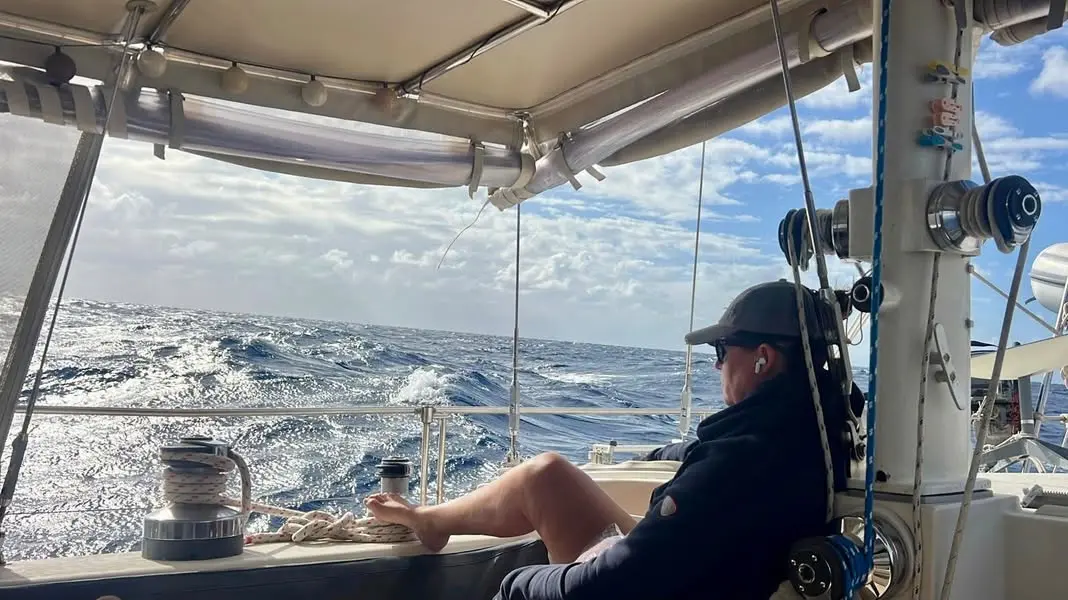
After about an hour under power, the promised wind finally appears. With just under twenty knots blowing diagonally from behind, the genoa billows out beautifully and My Motu comes to life again. The boat heels slightly, the water rushes past the hull, and with every mile it feels as if we are exactly where we are supposed to be again. Sailing gives a sense of freedom that is hard to capture in words.
Not long ago, Peter asked me if sailing with just the two of us has become much harder now than when Rajesh was still on board.
The honest answer is: yes and no.
Yes, because with two people we simply get less sleep. During nighttime crossings, Jeroen and I take turns on watch, which means the rest periods are shorter than they used to be.
But at the same time, we are fortunate that My Motu is an Amel, a sailboat designed to sail comfortably and safely, even with a small crew. Thanks to the many electrical systems, we can operate virtually all the sails from the safe cockpit. That makes sailing with two people much easier than on many other sailboats.
Do we miss Rajesh? Absolutely.
Not only because of the extra hands on board, but especially because he is part of our team and our family. At the same time, we also feel immense pride. It is wonderful to see how he is now spreading his own wings, discovering the world, and following his own path. That is exactly what we have always wished for him.
We had not been to or around Savusavu before. Fortunately, Wiebke and Ralf from SV Flora already knew the area well, so before we left, we asked them for some practical tips. One of the most important questions we always ask when visiting a new destination is whether it is safe to arrive there after dark.
Their advice was clear: do not sail directly to the mooring field at night. Not all mooring balls are equally visible, and surrounding some are shallows and coral heads that are easily overlooked in the dark. Should you arrive after sunset anyway, they advise that it is much safer to first anchor at the Cousteau Resort, approximately three nautical miles before the mooring field.
After checking out this anchorage on NoForeignLand and Google Maps, it gave us peace of mind. No matter what time you arrive, there is a safe place to spend the night and cover the final miles to Savusavu in daylight the next morning.
Nevertheless, it remains our guiding principle to enter new destinations during the day whenever possible. Not only because reefs, shallows, and other obstacles are much more visible then, but primarily because it simply provides a much safer and calmer feeling when sailing into an unfamiliar anchorage for the first time in daylight.
The sailing trip is proving particularly pleasant. We see rain showers hanging all around us, but they keep passing just in front of us or disappearing behind us again. Fortunately, they have hardly any influence on the wind this time, allowing us to sail on calmly without having to constantly adjust the sails.
Just before sunset, we eat a plate of chili con carne and finish with a cup of coffee. Not much later, our watch system begins. Since Rajesh left the ship, we have been trying to stand watch for four hours at a time during longer crossings and then take turns. So far, we are enjoying it surprisingly well. It allows you to still get a few hours of sleep in a row.
The night passes without incident. Fields of clouds alternate with clear patches of sky filled with twinkling stars. The ocean breathes calm, and apart from the soft murmur of the water against the hull, it is silent.
During my watch, I listen to The Norwegian Daughter by Soraya Lane. I have now arrived at the seventh part of her series. The Lost Daughters . I previously devoured all the books in the series. Are you, like me, a fan of The Seven Sisters If you’re interested in Lucinda Riley, then I can highly recommend the books by Soraya Lane. They have that same delightful combination of family history, mystery, love, and faraway destinations, making the hours during a night watch seem to fly by.
Slowly the sky begins to change color and night gives way to a new day. At the same time, the waves are also slowly building up. They are getting slightly higher, but because they are coming from diagonally behind, they actually give My Motu an extra push in the right direction. The boat regularly surfs down a wave, meaning our speed is sometimes nearly 9.5 knots.
After a delicious breakfast, Jeroen crawls back into bed for a moment to catch some extra sleep. I stay sitting outside and enjoy the rhythm of the ocean. The endless waves, the sound of the water against the hull, and the fresh sea air ensure that the hours pass unnoticed.
When Jeroen wakes up again, we check the latest weather forecast and our position together. We still have just under 65 nautical miles to cover. If the wind continues to behave as it is now, we expect to arrive around eleven o’clock at night. That actually feels quite nice. Thanks to Wiebke and Ralf’s tips, we now know that we can safely anchor at the Cousteau Resort if we don’t arrive until dark.
Naturally, the fishing line is out during such a crossing as well. We regularly see large groups of seabirds circling above the water, a sign that schools of fish are often swimming underneath. Several times we change our course slightly to sail towards them, but each time the birds seem to choose a different direction along with the fish precisely at the moment we get closer. As if they are just a little too clever for us. Consequently, the rod remains empty during this crossing, and we laughingly decide that it will simply be pasta bolognese tonight.
In the course of the afternoon, the wind picks up a little further. For a brief moment, we wonder if we might still be able to enter before sunset, but that proves just not feasible. Around half past six, we sail into the pass. Almost immediately, the ocean waves disappear behind us and we enter the sheltered water on the inside of the reef. It is dark by now, but the tension of the ocean gives way to calm.
Sailing, we cover the last two nautical miles towards the anchorage at the Cousteau Resort. Jeroen stands at the front with a powerful flashlight to clearly see any obstacles and to keep an eye on the other boats in the bay. We choose a spot a little further back in the bay and drop anchor at a depth of twenty-two meters. As soon as My Motu comes to a standstill and the anchor has dug in firmly, the engine can be switched off. Peace.
While Jeroen finishes the last tasks on deck, I head into the galley to prepare the pasta bolognese. With a good glass of red wine, we toast together to another beautiful and relaxing crossing. Sometimes happiness doesn’t have to be complicated.
We sleep wonderfully that night. The next morning, we immediately see that there is already more wind outside the pass. The waves continue to build and dark clouds hang over the ocean. The bad weather, which had been warned about, is now clearly on its way. We are glad that we made it across safely.
Motoring at a leisurely pace, we make our way to the Savusavu mooring field. We decide to take a mooring buoy from Waitui Marina first. As soon as we call the marina on the VHF radio, a staff member comes sailing up almost immediately to help us pick up the mooring. Afterwards, our details are noted down, and we are kindly asked to report in as soon as we go ashore.
Once the dinghy is in the water and the outboard motor is mounted, we grab our shopping bags and sail to shore. First, we check in at the marina, and then it is time to explore Savusavu.
Savusavu immediately feels very different from the larger towns in Fiji. It is a small, easy-going town where time seems to move a little slower. Along the main street, you will find everything a sailor needs: a few supermarkets, a lively market with fresh fruit and vegetables, small bakeries, and a few shops for daily necessities. Savusavu is not big, but that is precisely what makes it so charming. For sailors, there are three marinas where you can rent a mooring buoy.
It is not a place where you spend days shopping, but rather a small town where everything revolves around the relaxed island life. People greet each other on the street, everyone seems to know one another, and no one seems to be in a hurry anywhere. It is precisely this easy-going atmosphere that makes Savusavu such a lovely place to stay for a few days or even weeks.
Across the bay lies the modern Nawi Marina, built on a small peninsula that feels almost like a little island of its own. You can easily get there from the center by dinghy. Upon arrival, we pay three Fiji dollars to use the jetty and then take a curious stroll around the grounds.
We see that Moana is there, but it turns out Mareike is not on board at that moment. When we spot an Indian restaurant, we decide to have a nice lunch there first. Afterwards, my eye falls on the wellness salon that Wiebke and Ralf from SV Flora had spoken about so enthusiastically. They had had a fantastic massage there, and honestly, after all those nautical miles, that doesn’t seem like an unnecessary luxury to me either.
When I walk inside to make an appointment, I suddenly see Mareike standing there. Because the interior isn’t very big, I wait outside for a moment. As soon as she sees me, a broad smile immediately appears on her face. It really is remarkable how quickly you find each other again in the sailing world. As if the months in between never existed.
We soon agree to come aboard her the following afternoon. By now, there are even more familiar boats in the bay, and everyone is bringing something to eat and drink. That promises to be another pleasant afternoon. Before we leave, I also immediately make an appointment for my massage.
That same afternoon, rain passes over Savusavu. Between the showers, we sail back to My Motu, which lies at her mooring around the corner.
We hesitate for a moment about whether we might move to the marina for the coming days after all. That would be more comfortable with the predicted bad weather, but the berth is considerably more expensive than a mooring buoy. Ultimately, we decide that the mooring is the best choice for us. My Motu is safe and sheltered there, and we still have eleven days before Tess comes aboard.
Since Rajesh started his own adventure, his cabin has slowly taken on a different function. Where his belongings used to be, our wingfoil equipment is now stored, along with a number of large paintings I am currently working on. Before Tess arrives, we want to get the boat fully guest-ready again.
Meanwhile, outside, the weather is showing its rough side. We hear from Barbara and Ralph that the wind in Fulaga is now blowing 35 to 40 knots. Fortunately, we had everything well prepared before we left, and both Flora and Lille Venn are safely sheltered there. Here in Savusavu, too, it is much cooler than we have been used to over the past few months. The strong wind, in particular, feels remarkably cold. At moments like these, we realize once again how lucky we are that we crossed over just in time.
While the rain taps against the windows, Jeroen is busy reorganizing the boat. We actually do this every time before guests come aboard. It is always a good moment to critically examine everything again. Do we really need it, or is it just taking up valuable space? On a boat, every centimeter is valuable, and every tidying session ensures that My Motu feels just a little bit more practical and spacious.
The bad weather is set to continue for a few more days. Rain showers follow one another in quick succession, and the wind continues to howl strongly through the bay. Since we are mostly sitting inside anyway, we decide to make good use of these days. There are still plenty of projects waiting that we hardly get around to while sailing.
For me, that means finally having time to get back behind the laptop. The SV My Motu website could really use a major update. I am further behind with my blogs than I am used to, and I am taking advantage of these rainy days to slowly catch up. It feels good to put all the experiences down on paper again, while they are still fresh in our memories.
In addition, I am also taking my other website, The World of Dots , under a critical microscope. There are always texts that could be better, photos that could be replaced, and small improvements that ultimately add up to make a big difference.
Between the showers, we sail to Moana, where Mareike is already waiting for us. It turns out to be an incredibly enjoyable afternoon and evening. We also meet Ruby, a solo sailor who has been underway for quite some time, and Iwa, whom we have continued to run into in the most unexpected places around the world for over three years now. Usually, it remained a short chat from the back, but now we finally have the time to really get to know each other better.
At the end of the evening, we agree to go out for dinner together one last time before everyone sails on.
That night, we woke up abruptly.
A bright light shines in through the skylight. At the same time, I hear a rattling sound and voices along the hull of My Motu. At first, I don’t know what I’m hearing. Still half asleep, I wake Jeroen up. Without saying a word, he jumps out of bed and runs outside.
I look out the back window and my heart skips a beat.
At the back of our boat, an enormous anchor suddenly appears out of the darkness. It slides dangerously close to our diving cylinders.
Within ten seconds, I am outside dressed.
Although we are safely moored to a buoy, a shallow coral reef is located directly next to us. In the dark, it turns out a large sailboat misjudged the route to Nawi Marina. Instead of the navigation channel, they sailed straight onto the reef and are stuck fast.
There is no time to think.
We immediately hang several fenders on our railing to prevent damage. Then the passengers throw a line to Jeroen, who securely attaches it to My Motu. On board the other boat, the line is wound onto a winch. Slowly, they begin to pull themselves towards us.
Everyone holds their breath.
Because it is pitch black, we cannot see the reef underwater. We have no idea how much space is left. Are they slowly pulling themselves free from the reef, or are they pulling us towards the coral? Every centimeter feels endless. We trust that our mooring can withstand the forces, while we wait tensely to see what happens.
Then suddenly a voice calls out from the other boat: “We are free!”
Jeroen immediately unties the line and calls out a few more instructions regarding the safest route back to the navigation channel. Very calmly, they reverse, past our boat, back to the channel. Only when they are safely back in deep water do we feel the tension drain from our shoulders.
What perhaps surprises us most is the calm with which everything unfolded. Despite the stress, there was no shouting or panicked yelling anywhere. Everyone remained calm, thought logically, and worked step by step towards a solution. It was precisely because of this that everything ultimately turned out well.
More than an hour later, we are back in bed. We don’t fall asleep right away. We talk about what just happened and try to understand how a boat could have ended up on the reef so far out of the shipping channel in the middle of the night. The longer we think about it, the less we actually understand it.
I suddenly ask Jeroen, “do you actually know what that name of the boat is?” He looks at me and shakes his head. “No idea.” I have to laugh. “Me neither.”
It all completely passed us by. At that moment, we were only focused on two things: ensuring they got off the reef safely and that My Motu wouldn’t sustain any damage. Who they were or what the boat was called simply didn’t matter at that moment.
It wasn’t until three days later, when we were sitting quietly in the cockpit, that we heard someone whistling loudly at us. Someone on a passing sailboat was waving enthusiastically at us. “Thank you!” he shouted, as the large, approximately 65-foot-long sailboat slowly sailed past. Only then did we realize that this was the boat we had helped that night.
We wave back enthusiastically and call out: “Safe travels!” Then they slowly disappear from sight, on their way to their next destination. We hope the rest of their journey goes a lot more peacefully than that fateful night.
We had also applied for our visa extension for Fiji online. A tourist visa is valid for a maximum of four months, but you can apply online to stay for another two months. We both submit the same application, but to our surprise, only mine is approved. Jeroen’s application is rejected, without a clear reason being given.
Jeroen therefore decides to visit Immigration in Savusavu to ask for an explanation. Fortunately, he encounters an incredibly helpful immigration officer. She carefully reviews the application, immediately contacts the colleague who made the decision, and promises that we will hear from her as soon as possible.
Two days later, the phone indeed rings. The employee explains that a mistake was made and apologizes for it. Jeroen’s application is also approved after all. We decide to wait a little longer before getting the renewal stamps in our passports. First, it is time for something we have been looking forward to for months: Tess is coming to Fiji.
We are waiting at the small Savusavu airport well in advance. The airport consists of little more than a simple waiting area under a large canopy, where departing and arriving passengers sit together comfortably. As is often the case in Fiji, we quickly strike up conversations with various people while we wait.
After more than an hour, we look towards the runway again, but no plane appears. Instead, a taxi suddenly stops in front of the entrance.
The back door opens… “Tess!”
Apparently, there were problems with her original flight. Because she had arrived in Nadi early, the airline had rebooked her to Labasa, on the other side of the island. From there, she had to take a taxi for well over an hour and a half to Savusavu.
We fly into each other’s arms. It has already been seven years since we last saw each other. Not much later, we walk together to the jetty, where the dinghy is already waiting for us to finally welcome Tess aboard My Motu.
At that moment, we could not yet imagine that Tess would say goodbye just a week later. First, a week full of new memories awaited us. What adventures did we experience together? We will tell you in the next blog.
MESSAGES ON BOARD
Leave a message
Share a thought, question or greeting. Aagje reads every comment before it appears here.
Loading comments…