
The next morning I was woken early by Jeroen. Mind you: the night before, after we had returned from the hospital, he had crawled straight into bed and slept like a log. That he already had plans to sail again was something I could not have imagined. While I was still in doctor mode, he was already “up and ready to go.” The wind was favorable to head towards Kadavu, and before I really realized it, I had started the engine, lifted the anchor, and Jeroen rolled out the sails.
“Twenty-eight knots of wind, but from behind, right?” I hear myself asking.
“Eh, no, it is a close-hauled course,” Jeroen says casually. With waves of about 2.5 meters coming from the side. “But they will ease in about three hours.”
Hmm. The boat can handle this just fine, but for us it is certainly not a comfortable course. Conditions I would only sail in if I really had to, because we had to be somewhere on time. Uncomfortable indeed: a passage that cuts right through you, when My Motu is lifted high by a wave and crashes back down on the water with a dull thud. The whole boat shakes, groans, and creaks, sounds that to my ears feel unnatural and ominous. Yet My Motu holds herself firm and unwavering. Thankfully, that same afternoon at 4:30 p.m., we were able to drop the anchor into clear blue water. The journey is soon forgotten when the next morning you eat breakfast with the endless blue of the sea, the fresh green of the trees, and birdsong weaving through the branches like music. A picture far removed from Suva, where cargo ships load and unload, grinding tools screech through steel, and the water laps brown and murky against the quay.
After breakfast, we went straight for the sevusevu. The chief sat somewhat bored in the shade under a tree, got up sullenly, and took us to his house. We sat on the floor, he accepted the kava, and thanked us briefly. “You may snorkel and walk,” he said, and that was that. No chat, no ceremony. Friendly but firm, we were sent on our way.
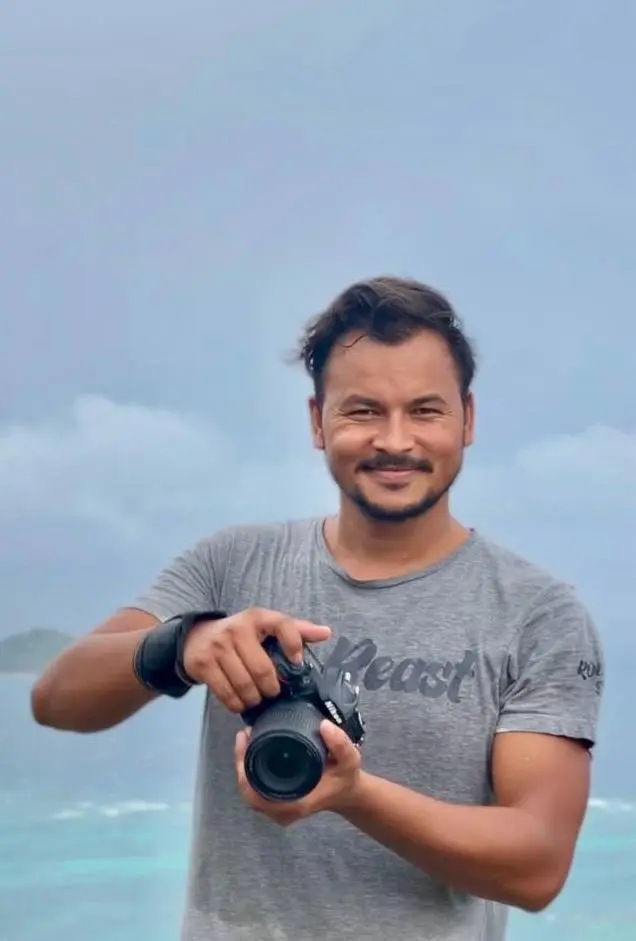
That afternoon we climbed to the top of the mountain. Hundreds of blue-tailed lizards darted away under the leaves, just in time not to be crushed under our feet. At the top, a 360-degree view awaited: an azure sea, a green ring of islets, and in the sky large groups of bats gliding by. Of all days, Rajesh had left his camera at home.
On the way back we met “Moon,” a 57-year-old man from the village. He picked a coconut from a tree for us, cracked it open, and we drank the sweet water while he told us that he and his brother were building a small house. Proudly, he showed us the beginnings of their project. Progress was slow since all the materials had to be brought in by boat, but they had time. Jeroen gave him some FJD, and the next day Moon brought a huge sack of bananas, papayas, sugar cane, and plantains. So much that we could not take it all; it would overripe before we could eat it. With a selection of fruit aboard, we lifted anchor and sailed on to Manta Ray Island, only five miles further.
There we dove into the water daily, searching for mantas. Their graceful wings under water, floating like angels, remain a magical sight. One morning Jeroen caught two tuna from the dinghy, which we later ate with relish. But when the wind shifted and the anchorage became uncomfortable, we decided to move on to North Buliya.
On the way, we saw smoke. At first, we thought it was a controlled burn, but closer up we saw much of the island was ablaze. Still, we went ashore: we wanted to visit the abandoned survival camp, once built for television recordings. Both the French version of Survivor (Koh-Lanta) and the German edition had used the site as their base camp. Entire facilities had been set up: sleeping huts, a catering kitchen, storage rooms, a jetty, and logistical buildings to house the crew for months. After the filming, the buildings were mostly left behind. Nowadays, villagers keep an eye on it, but otherwise, nothing is done with it. A place with potential, now lying like a ghost village among the trees.
A woman who stayed there with her husband as caretaker had not noticed anything yet. Together we walked to a spot where the fire was clearly visible. She looked, shrugged, and said there was nothing they could do. “No fire brigade to call, no plane that can scoop seawater to help extinguish… this is just bad luck.” I listened in disbelief, but later we heard the fire had started in the village on the other side of the island. Luckily no one was injured and the village itself was spared. Rajesh filmed impressive footage, but when the smoke drifted towards our boat, we chose to leave for Dravuni.
There the wind died, and for two days there was calm. The perfect moment to anchor at the north pass. What we saw underwater there surpassed everything: colorful coral, caves, steep drop-offs at the reef, and schools of fish, large and small. A day that made us fall even deeper in love with Fiji.
Then came the day Jeroen had to return to the hospital for a check-up. I quickly made yogurt, baked bread and cake, and thought about what we would eat that evening. At a quarter past three we lifted the anchor and set course for Suva. It became a beautiful night sail, and at half past midnight we dropped the anchor in the bay.
The next day we went to the hospital for Jeroen, where we received good news that everything was calm and that he should continue with stomach acid blockers for now. Outside Suva, the wind howled and the waves built, but we lay sheltered. Waiting for a good weather window to sail to Denarau, we enjoyed the small pleasures of the city. Even in the marina: a pool table and a dartboard, where we entertained ourselves almost daily with a game. Small joys while we waited for the big adventure ahead.
Meanwhile, Rajesh prepared to leave the boat, and I truly felt the rollercoaster of emotions racing through me. As he got ready to step off our deck and begin his own journey in India, my heart felt like a compass spinning in all directions. Pride swelled in me like a sail filling with wind, because I could see what a strong and independent man he had become. Sadness crept in like the tide quietly retreating from shore, knowing that his laughter and footsteps would no longer fill our days onboard. Trust kept me upright like the mast that withstands every storm, reminding me that the roots we gave him would carry him safely. And yet, softly but constantly, there was an undertone of worry, like the singing of the lines in a restless breeze.
“It feels comfortable and safe here with you,” Rajesh said softly, “but I know it is time to learn to stand on my own feet. That is difficult, because I am leaving so much behind… and at the same time I am excited. It feels double: scary and hard, but also like something I have to do. I know it will be hard work, with ups and downs, but that is part of life. What comforts me is knowing that you will always be there for me, wherever I am, whatever course I choose.”
For this farewell does not stand alone. It is interwoven with the path we have traveled together:
Some encounters change your life forever. For us, that was in 2014, when we gave free dental care in India. That is where we first met Rajesh. What began as a chance encounter grew into something much bigger. Before long, he was no longer to be imagined out of our lives, and bit by bit, he became part of our family.
In the years that followed, we shared countless memories. He lived with us in the Netherlands for seven years. We traveled together across Europe, took vacations in India, discovered new places, and grew closer as a family. Rajesh was there on ordinary days—school, sports, birthdays—but also on the special moments that shaped us as a family. And then, three years ago, a new adventure began: crossing the ocean together on the boat.
At first, Rajesh was skeptical. He did not like water, and the idea of living on a sailboat seemed like nothing for him. But after our first vacation on the boat, that changed. He discovered the underwater world, a completely new dimension, and became enchanted by everything there was to see. Now he swims better than any of us and can stay under water the longest. With endless patience, he films everything he encounters. And when he later selects the most beautiful fragments, we often sit together in the evening, watching and talking about what we have seen. These are moments we will deeply miss onboard.
For three years we lived as a family at sea. We anchored in turquoise lagoons, snorkeled among mantas, whales, and sharks, but also endured storms together and spent sleepless nights on watch. Sometimes it was hard and intense, because life on a boat is not always romantic. Yet it was precisely those moments, the ups and the downs, that brought us closer together and created unforgettable memories.
Now, nearly eleven years after he came into our lives, the moment has come: Rajesh is returning to India. To build his own life there, to find his own course. And although saying goodbye hurts, pride dominates. Pride in the young man he has become. Pride that he has the courage to shape his future.
For us, it feels like a new chapter is beginning. We know we will experience the empty-nest syndrome. A boat that feels bigger, a table that seems emptier. However, at the same time, space has opened up. Space to look ahead and think about what the future will bring for the two of us.
That future looks promising and exciting. First, a few practical matters await us here in Fiji. Jeroen is building a greywater tank in one of the bathrooms (mandatory in New Zealand), and we are installing two new AGM batteries. Once everything is ready, we will wait calmly for a good weather window. And then… then our first major passage as just the two of us awaits: the voyage to New Zealand, about 1,200 nautical miles, which we hope to sail in around eight days. It feels almost symbolic. Where Rajesh will set his own course in India, we will continue ours, now as the two of us. We dream of a life in which we continue to combine sailing with periods of working in the Netherlands. A balance between freedom and connection, between adventure and coming home.
Perhaps that is the greatest lesson this life teaches us: that holding on and letting go can go hand in hand. That love does not disappear when someone goes their own way, but deepens in trust. From this boat, where we have shared so many memories together, I see Rajesh heading towards his own horizon. My heart feels heavy and light at once, broken open and yet strong enough to let him fly. It is both the sorrow and the wonder of motherhood: to love so deeply that letting go becomes the purest form of trust.
And then the day of departure comes.
On September 24, at six o’clock in the morning, we drive to the airport. I feel the tears burning behind my eyelids, while I do my best to hold them in. The last hugs follow, warm words of luck and trust, and then the moment when he walks through the gates and slowly disappears from view.
“Good luck, son. Love you always.
Mom and Dad.”
MESSAGES ON BOARD
Leave a message
Share a thought, question or greeting. Aagje reads every comment before it appears here.
Loading comments…