
After Albert left to surprise Anneke in America, we quickly stocked up on provisions and picked up our mainsail from the sailmaker. A tear had been neatly repaired, and once it was hoisted back in place, we felt ready for the next leg: the passage to the remote Lau Group.
That evening, however, the promised wind completely died, and we ended up motoring for nearly twenty hours. Eventually, we decided to stop at Kadavu, where we enjoyed a few days of island calm. We performed several short sevusevus; the chiefs appreciated that we followed the traditions, though one of them preferred a bottle of liquor over the customary kava. To us, that was a slight disappointment; a sevusevu is meant to be about respect and connection, not about alcohol. It ended with a simple “thank you, you may anchor and snorkel here,” and the formality was over.
Luckily, nature made up for everything. Kadavu is known for the oceanic manta rays that swim year-round around a cleaning station. With wingspans of up to seven meters, sometimes nine of them gather at once. We were euphoric when we spotted the first ones, graceful giants with wingspans of more than five meters, gliding past us in utter serenity. Their calm presence underwater was nothing short of magical.
After three days, the wind finally shifted in our favour, and we set course for the Lau Group, often compared to the Tuamotus in French Polynesia. We could hardly wait.
But as every sailor knows, it’s never a question of if something breaks, but when. And, of course, it always happens at the worst possible time. Out at sea, we discovered that the entire engine room was flooded. Fortunately, Jeroen noticed it just in time, before the engine or electrical systems suffered damage. After endless pumping with the bilge, we could finally inspect. The culprit turned out to be the generator’s exhaust: instead of discharging hot water outside, it was dumping it straight into the boat.
With some quick improvisation, Jeroen managed to shorten the exhaust and make a clever modification. To our relief, the generator roared back to life and just in time, as cloudy skies were preventing our solar panels from doing their job.
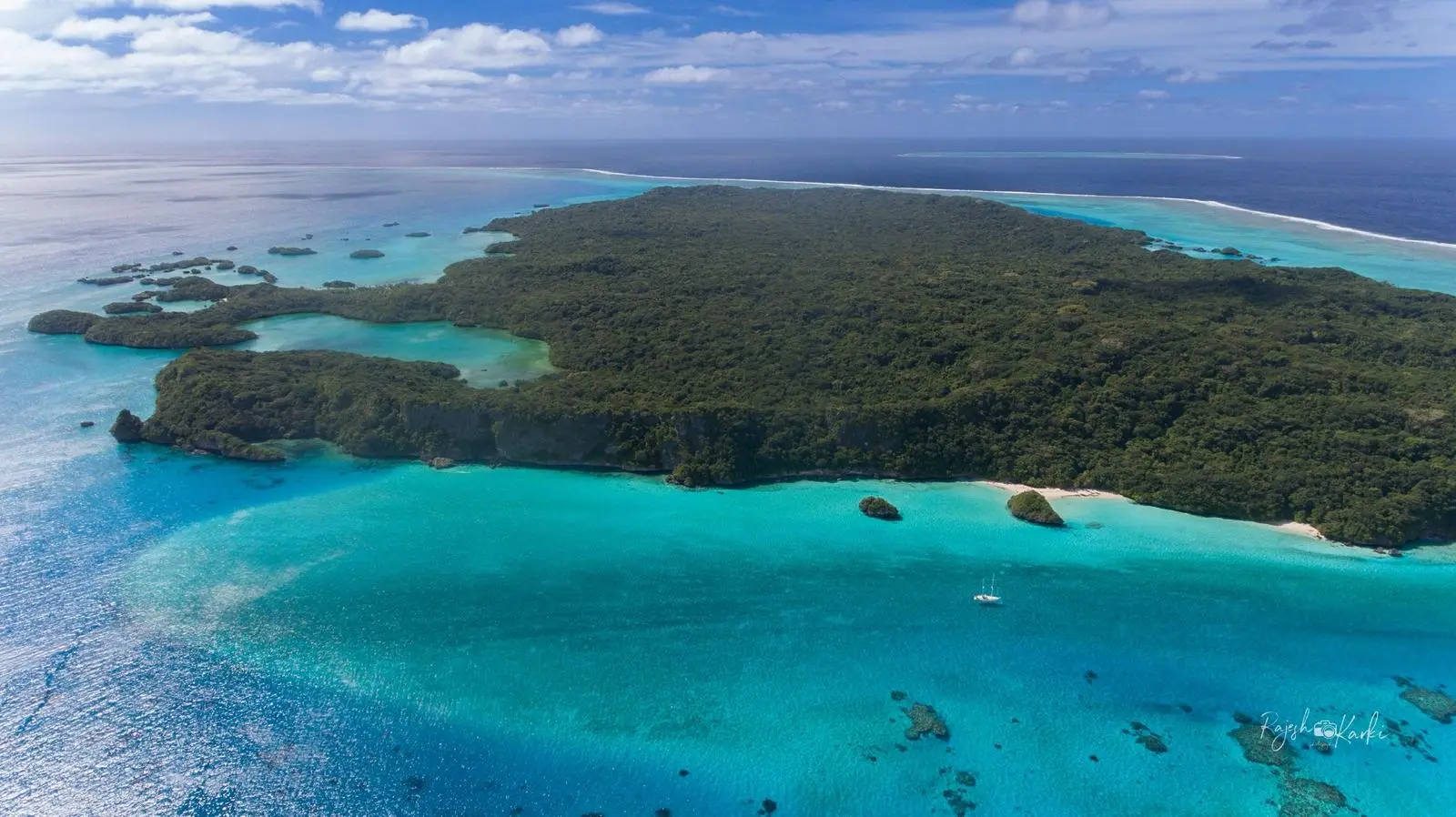
After two more days of sailing, the outline of Ogea appeared in the early morning light. By eight o’clock, we dropped anchor in crystal-clear blue water. Before us lay a new chapter, full of encounters, traditions, and stories waiting to be discovered.
On Ogea, we experienced our first more traditional sevusevu. It’s immediately clear that few sailors come here. For the children, we were mostly an attraction, first giggling from a distance, then, as curiosity grew, edging closer and closer.
The village has about 85 inhabitants, of whom 23 are children under the age of 14. Once they reach that age, they leave for Suva to live with family or friends and continue their education there.
We were welcomed into the chief’s house. A group of children shuffled into the circle with wide, curious eyes, and not long after, his wife joined us too, adding warmth and homeliness to the gathering. The simplicity and respect of the ceremony made it an unforgettable moment.
Because Ogea is so remote, you notice that the villagers can use certain supplies. Clothes, toothpaste, and toothbrushes, for example, which I happened to have brought along. Reading glasses, sunglasses, fishing gear, snorkels, and fins are also much appreciated. Rajesh even raided his own wardrobe and donated several shorts and shirts, gratefully received with broad smiles.
The village itself is working on a special project: raising money to build a low wall. During December and January, heavy rains and higher tides often flood the village. With this wall, they hope to prevent it in the future. The community lives simply and largely self-sufficient, with fish, cassava, taro, and coconut forming the basis of their meals. At the same time, there’s a strong bond with the rest of Fiji: many families have relatives living in the cities. They are not entirely cut off, but when sailors arrive, it often means just that little bit extra.
The Legend of Burotukula
In a place like this, where stories are still shared by the light of a kerosene lamp or in the shade of a mango tree, old legends live on. One of them is the tale of Burotukula, the Lost Island.
The story tells of a fisherman from Matuku who drifted far out to sea and awoke on a shore that shone with light. He found trees that touched the heavens, flowers that bloomed without end, and women so beautiful they seemed more like spirits than humans. One of them gave him gifts: a handful of earth, a little shimmering sand, and a feather from a rare bird. When he awoke the next morning, he was back on Matuku with the gifts still in his hand.
The villagers, eager for the paradise he described, sailed out to find it, but the ocean kept its secret. Some whisper that the chieftainess of Burotukula sank the island to protect it from human greed. Others say it reveals itself only to those who are not searching. Even in the 1990s, fishermen claimed they glimpsed a shining island during a cyclone, just before it vanished again into the mist.
For Fijians, Burotukula is no fairytale but a story with weight. Some link it to Bulu, the realm of the ancestors; others see it as a paradise never meant to be possessed. Whether it is a memory of a sunken island or a gateway to the afterlife, no one knows for sure. But the legend still whispers with the wind across the Lau Group, as if, on a quiet morning, you might just see it appear.
That evening, as we walked back to our boat, I felt how these stories gave a deeper layer to our own existence here. Because living on a sailboat in these remote waters always means balancing between freedom and vulnerability.
When Jeroen became ill, that truth hit hard. For some time, he had been suffering from pain in his side, and because he is not someone who complains easily, I knew it was serious when he mentioned it. With a bit of our own research, we suspected it might be his gallbladder. That gnawing thought: what if it gets worse? What if we can’t do anything out here, so far from help? Exposed our fragility all too clearly.
After some hesitation, we raised anchor and set course for Suva. With the wind at thirty knots on our quarter, it felt as if we were flying. My Motu raced forward at more than eight knots, water foaming along her hull. Forty hours later, as dusk settled, we dropped anchor in Suva Bay.
The next morning, the city revealed itself. The water around us was brownish-green from river runoff and the bustle of the port. Beyond lay a landscape of tropical greenery and gently rising hills, with the skyline of Suva behind it: a lively mix of modern buildings, busy markets, and colonial architecture.
Before our hospital appointment, we stopped by immigration, where we extended our visas until the end of November. Then came the doctor’s visit. After blood tests and ultrasounds, another appointment was scheduled for more thorough examinations.
For those, Jeroen was given sedation. To him, it felt as though he had landed in a colourful cartoon, mixed with a never-ending rollercoaster. Voices echoed in the distance, while he sensed hands pressing on his stomach. No pain, just a surreal haze that later left him with the most bizarre stories. When I saw him in the recovery room, he recounted everything in vivid detail, as if he had been on a dream journey rather than a medical procedure.
Soon after, the doctor gave us the results. The diagnosis was clear: a stomach ulcer and a thickened gallbladder wall. Not pleasant news, but thankfully treatable. With medication and a change in diet, he could continue.
And typical Jeroen: while I was still half in “doctor mode,” he was already darting around the next day as if nothing had happened. Yet the awareness lingered that everything we have out here is fragile. One unexpected event can turn your whole world upside down.
Perhaps that is exactly what makes the Lau Group so special: between the old legends and the simple villages, between myth and reality, you are reminded how thin the line really is between paradise and vulnerability.
MESSAGES ON BOARD
Leave a message
Share a thought, question or greeting. Aagje reads every comment before it appears here.
Loading comments…