
While we were anchored at Kadavu, October 1 was getting closer and closer. A date that had been on our calendar for quite some time, although I had not really given it much thought. We were going to sail to Vuda Marina and then step aboard another boat. Not for a few days, but for three whole months. Since leaving the British Virgin Islands in July 2022, My Motu has been much more than just our boat. She has been our home, the place where we sleep, cook, laugh, occasionally grumble, make plans and where almost all our adventures begin. Of course, we have left her behind for a while on several occasions during our travels, but this time felt different. Normally, after a trip away, we return on board and continue our journey with My Motu. This time, we would be making a serious ocean passage ourselves while she remained in Fiji. A completely different kind of adventure, and we were actually very curious to discover what it would be like.
By now, we know every little sound My Motu makes, every creak and almost every one of her peculiarities. We know how she responds to the waves, when she is sailing beautifully and when conditions are making her work a little harder. She has carried us from island to island, from country to country and eventually through the Panama Canal into an ocean that would completely change the way we travel. Because although we have now sailed thousands of nautical miles across both oceans, the difference between the Caribbean and the Pacific is enormous.
In the Caribbean, everything is relatively close together. Often, you leave in the morning, hoist the sails and drop anchor again at the next island by late afternoon, sometimes even in another country. Of course, there are longer passages, and the Caribbean has its own challenges, with squalls, currents, sargassum and sometimes an incredible amount of traffic on the water, but somehow it all feels manageable. You can change your plans relatively easily, stay somewhere a few days longer or decide to visit another island without it immediately affecting the rest of your route.
And then you sail through the Panama Canal.
You enter on one side, and a few hours and several locks later, an entirely new ocean lies ahead of you. The Pacific. Even the name sounds different.
From Panama City, we first sailed to Las Perlas, and I think that was where we began to notice that something had changed. Nature seemed bigger, perhaps a little wilder, with humpback whales, dolphins, sharks and enormous tuna making the marine life around us feel more impressive than ever. But something else had changed too, something that would have an even greater influence on the way we travelled: the distances.
Beyond Panama, the next island is no longer just a few hours away. Instead, you have to make decisions that determine where you might find yourself several months later. Do we sail north along the coast? Head towards the Galápagos Islands? Perhaps Easter Island? Or do we point the bow west and begin that enormous crossing towards French Polynesia? Suddenly, you are no longer talking about sailing through one night, but about spending weeks at sea.
And yet, that is exactly what attracts us to this life. The unknown beyond the horizon, that extraordinary feeling when land finally appears after days or weeks at sea, and the curiosity about what we might discover when we arrive. A new island, a different culture, people living in ways completely different from what we are used to, and places we might never have visited if we had not been travelling on our own boat.
By now, many weeks and countless nautical miles have passed. We have explored French Polynesia, the Tuamotus, the Cook Islands and eventually reached Fiji. We have visited places we barely knew existed a few years ago and experienced things we could never have imagined would become part of our journey. That unpredictability is precisely what makes travelling so special, because no matter how carefully you try to plan something, reality often turns out to be completely different and quite regularly even more beautiful.
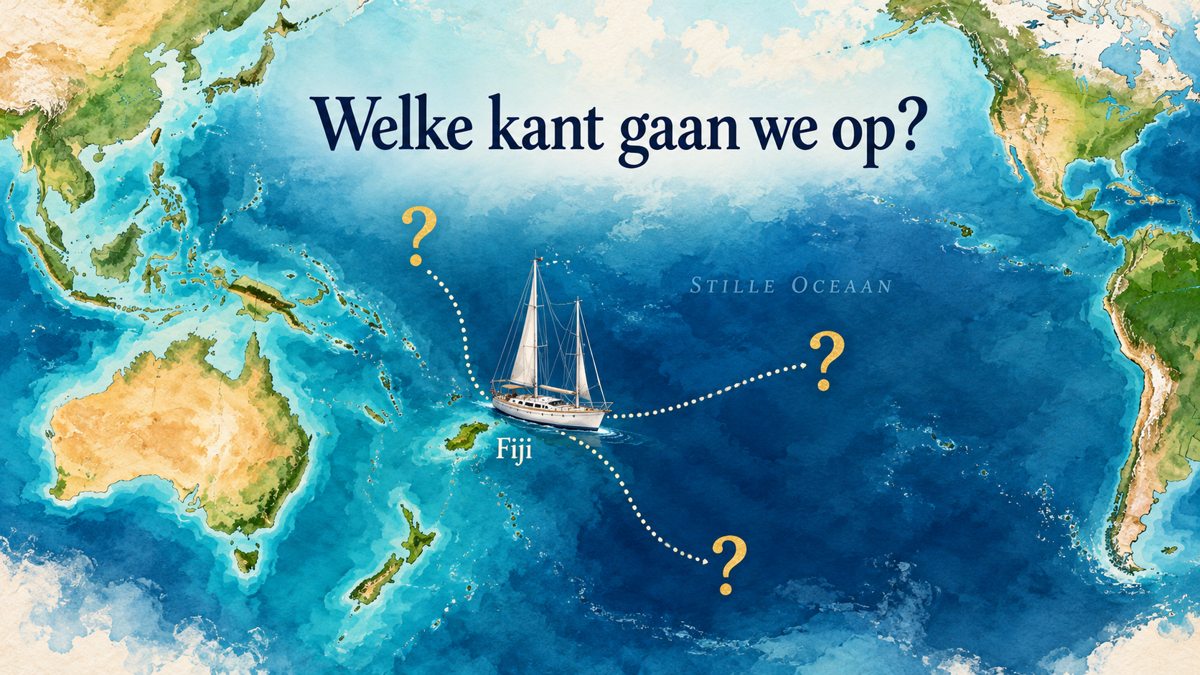
And now here we are, on the other side of the world, asking ourselves that familiar question once again: where do we actually go from here?
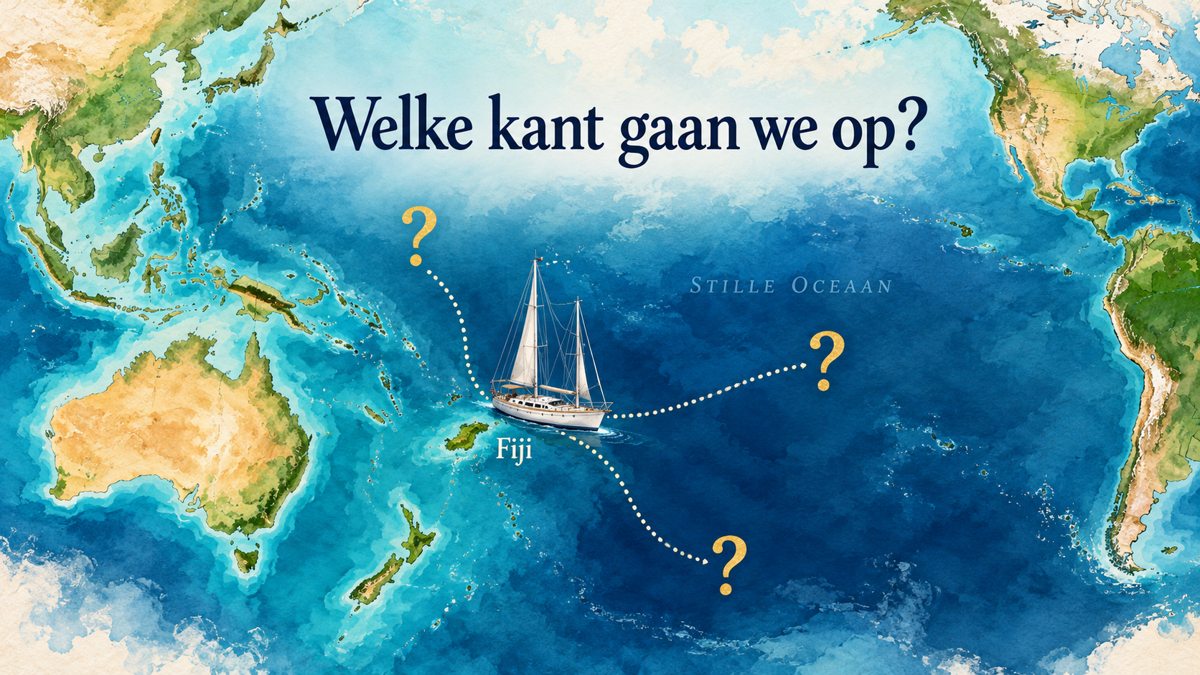
On a world map, it all looks so simple. You just draw a line further west, towards Vanuatu, New Caledonia, Australia, Papua New Guinea and Indonesia, because after all, the world is still waiting to be explored. And of course, we are curious about those countries, their nature, their people, their different cultures and everything we might discover there. There are still so many places we would love to see with our own eyes, but the longer we travel, the more we realise that choosing a route involves much more than simply drawing a line on a map.
We regularly talk to sailors who are a few years ahead of us, people who have already continued further west towards Papua New Guinea and Indonesia, and remarkably often we hear the same words: 'Enjoy the Pacific. This is the most beautiful part.'
Of course, that is a matter of personal preference, because what one person finds wonderful might not appeal to someone else at all. But we also hear stories that make us think. Stories about increasingly busy waters, enormous numbers of fishing boats, nets and fishing lines, and small vessels without AIS that are almost impossible to see at night. We hear about ropes becoming tangled around propellers and even boats colliding with anchored yachts.
If we had heard just one such story, we probably would not have thought much of it, but by now we know of at least five boats whose crews have had similar experiences. That certainly does not mean it is like that everywhere or that the same things will happen to us, but it does make us look at the next part of our journey a little differently.
Because although we are still curious about what lies ahead, we increasingly find ourselves wondering why we should be in such a hurry. After all, we have no deadline by which we must arrive somewhere, and nobody is telling us which route we have to follow. Yet somewhere along the way, a certain expectation seems to creep in almost unnoticed. Other sailors keep moving on, so perhaps we should do the same. As though there were some unwritten rule that you are only truly sailing around the world if you keep adding new countries to your list.
But who came up with that rule anyway?
Perhaps it also has something to do with how much we love being here in Fiji. We can snorkel and dive, the underwater world is beautiful, and after spending weeks in remote areas, it can be wonderful to arrive somewhere with fresh vegetables, fruit and other groceries again. But more than anything, it is the people who make us feel so at home here.
The Lau Group in particular has stolen our hearts, with its small villages, the traditional sevusevu ceremonies, the warmth with which people welcome you and that special feeling that you are not simply anchored somewhere, but are allowed to become a tiny part of a place for a little while. It is those simple encounters that stay with us, when someone invites you inside, puts the kettle on and a visit that was only supposed to last a short while somehow turns into a much longer one.
It reminds us of the Tuamotus in French Polynesia, another region where we could easily have stayed much longer than we originally planned. Perhaps those are the places that suit us best. Not the busy tourist destinations where everything is readily available, but the small islands where life is simple and the ocean still plays such an important role in everyday life.
The weather also plays a part, because since April we have regularly felt that conditions have been different from last year. More changeable, more unsettled and especially colder, while the forecasts often seem less reliable too. A beautiful sailing day with fifteen knots of wind can suddenly turn into hours of motoring because the wind has dropped to six knots, while a supposedly calm weather window can turn out to be far rougher than predicted.
But then again, nature does not read our weather apps, and perhaps we do not always need to follow our own plans quite so strictly either. After all, we started this adventure because we wanted more freedom, and apparently that also means making plans only to change them completely later.
And that is exactly what we have done.
Because one thing was certain: My Motu would not be sailing to New Zealand this year.
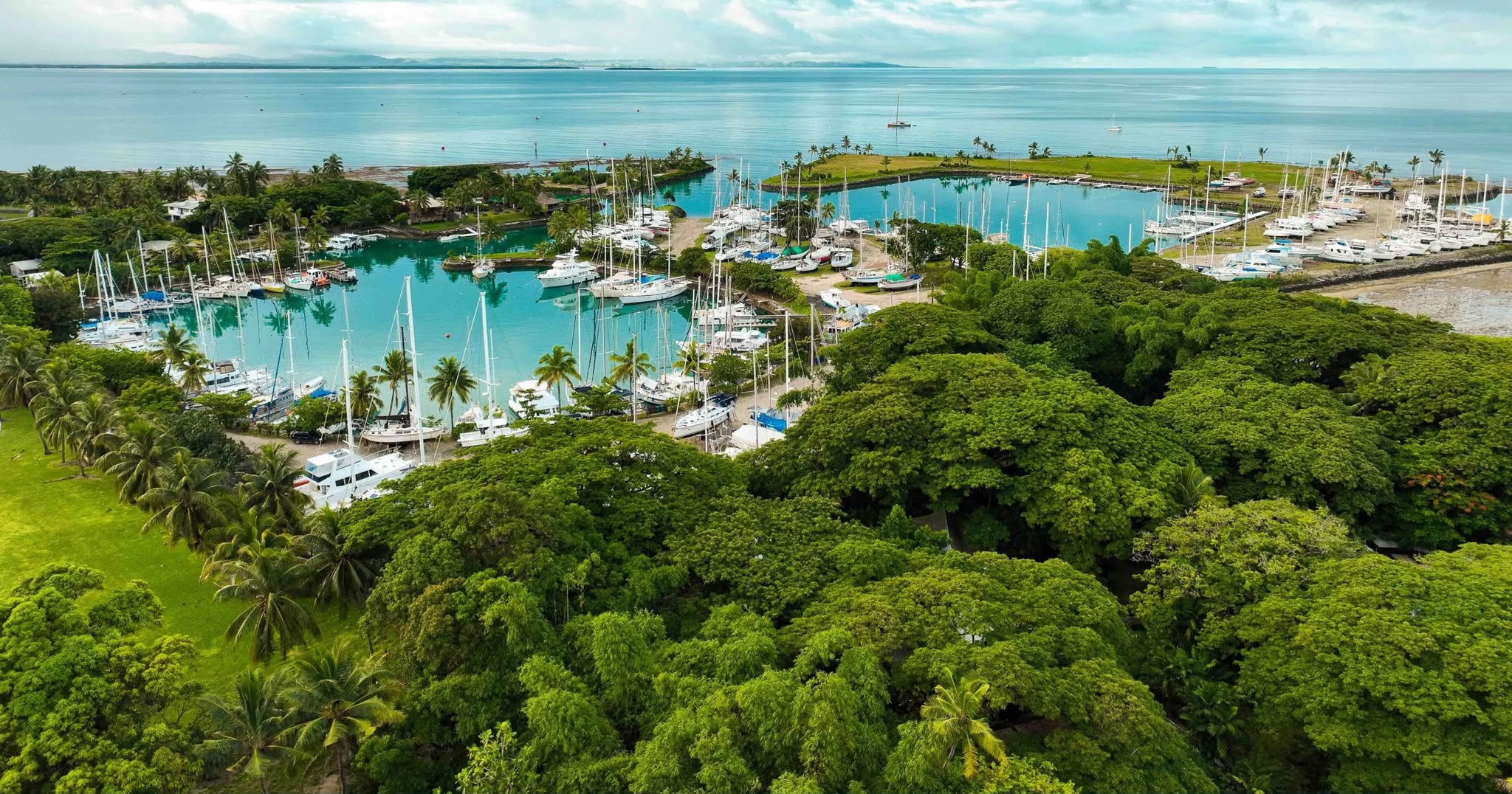
On September 28, we headed towards Nadi, and not long afterwards she was safely moored in Vuda Marina. We prepared her as carefully as possible for the coming months. Anything that could catch the wind had to be removed or secured more firmly, mooring lines were checked and doubled, and equipment was safely stored away. Cyclone season is approaching, and although you can never eliminate every risk, we naturally wanted to leave with peace of mind.
Fortunately, however, we did not have to say goodbye to sailing.
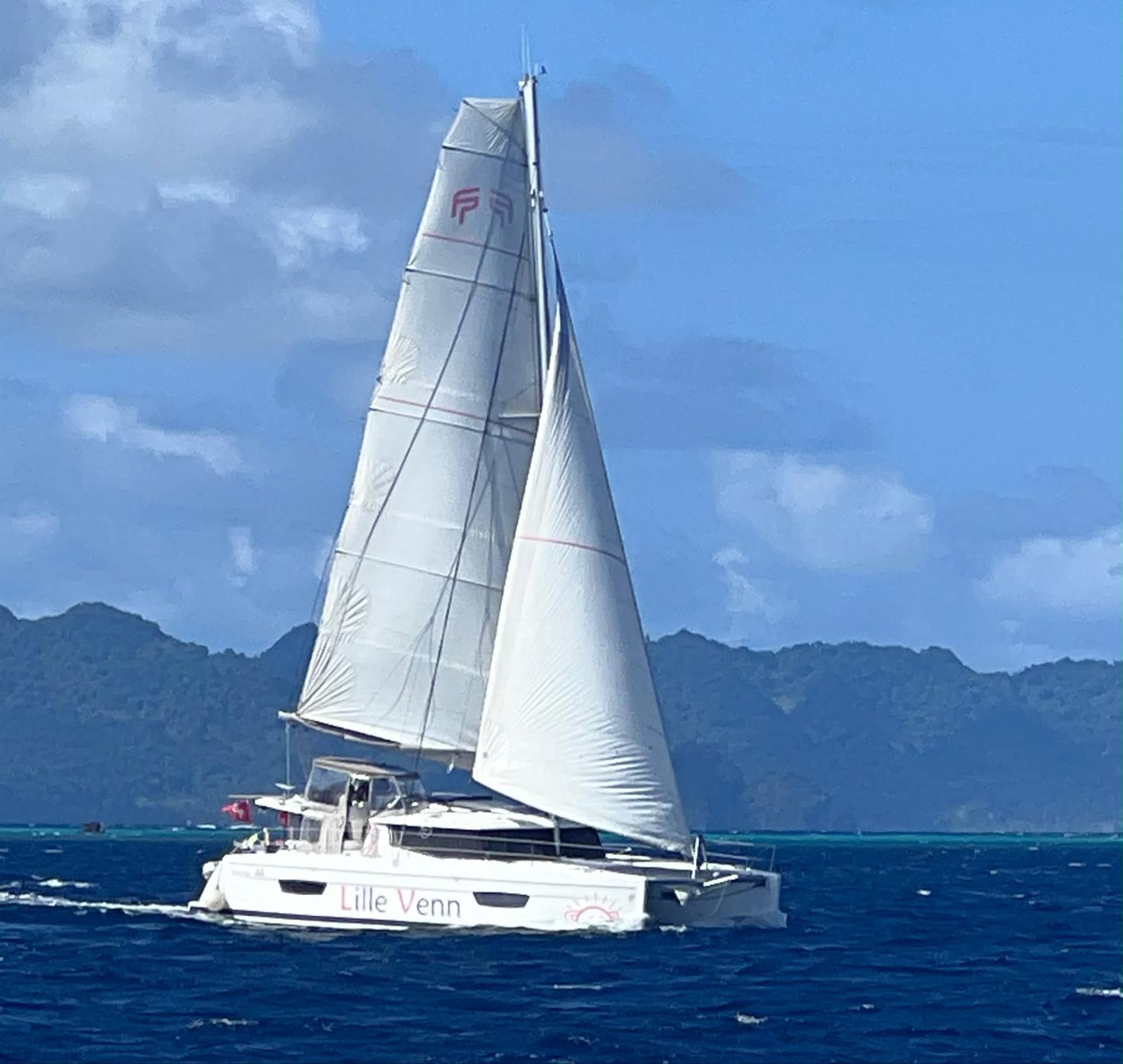
Ralph, from Lille Venn, wanted to sail his catamaran to New Zealand. Barbara was temporarily in Switzerland, and he was looking for crew for the crossing. Suddenly, several pieces of the puzzle seemed to fall neatly into place. Jeroen and I were ready for another adventure, Ralph could use some extra hands, and we had the opportunity to experience what a substantial ocean passage would be like aboard a catamaran.
After sailing thousands of nautical miles on our own boat, we would suddenly be joining someone else as crew. No longer responsible for our own floating home, where we know exactly how everything works and where everything is kept, but aboard a boat with a completely different layout, different systems and undoubtedly very different sailing characteristics.
And to be fair, we found the idea a little exciting, but most of all, we were really looking forward to it.
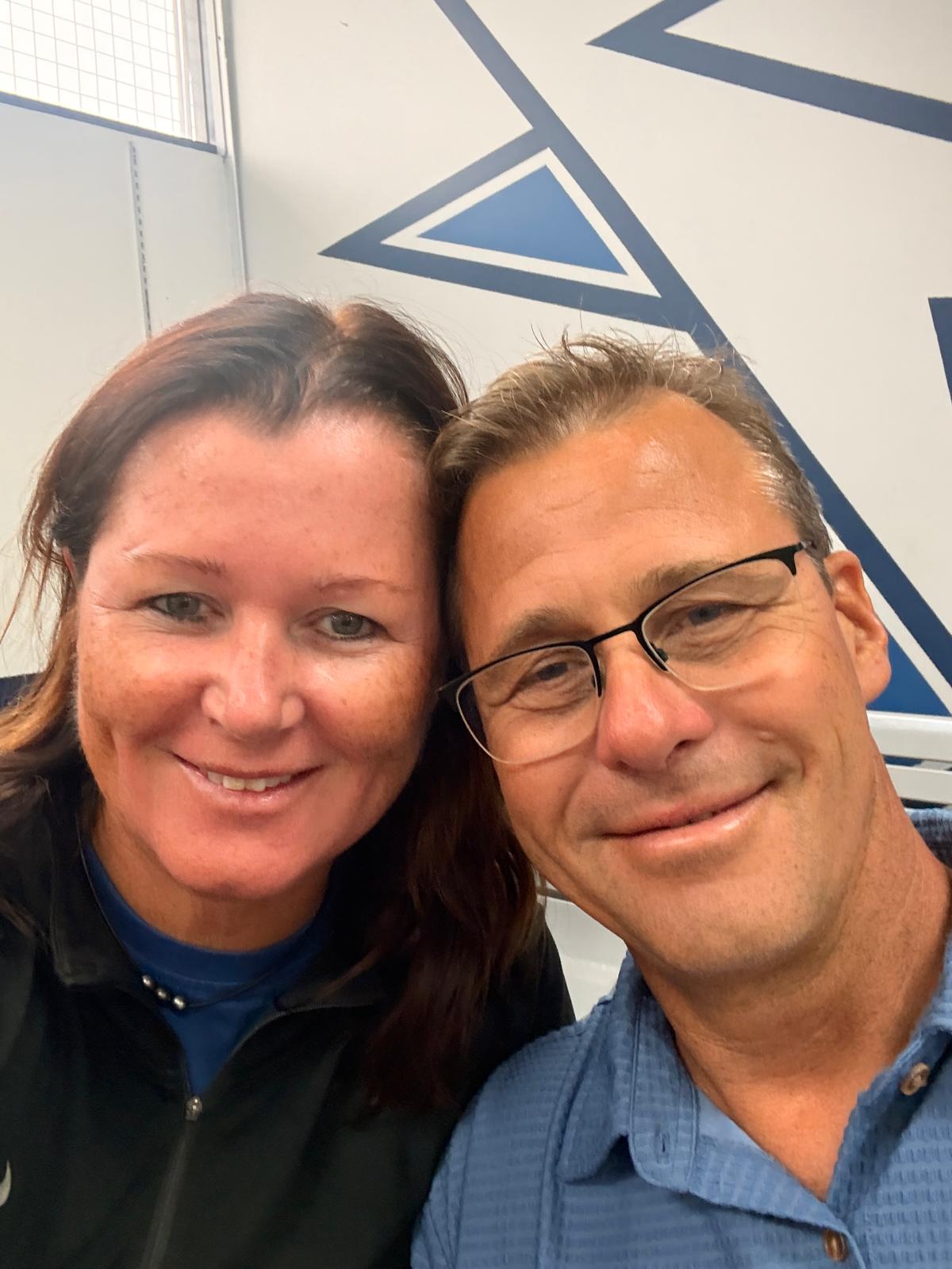
On October 3, we flew from Nadi to Suva, where Ralph was waiting for us aboard Lille Venn. That very same day, we set off again, this time heading south aboard a catamaran.
Our first destination was Minerva Reef, an extraordinary place in the middle of the ocean that we had heard so much about but had never visited ourselves. After three days at sea, we arrived, and we are now anchored in a place that is almost unbelievably beautiful.
But I will tell you much more about that in another blog, because Minerva Reef definitely deserves a story of its own.
If the weather cooperates, we will soon continue towards New Zealand, where we hope to spend a little time exploring before our next adventure begins. Because in the second half of November, we are flying to India to visit Rajesh!
And that is something we are really looking forward to. After all these months of islands, anchorages, reefs and sailing passages, it will be wonderful to spend some proper time with our son again. Not just a quick visit for a few days, but time to be together, catch up, do things together and simply enjoy each other's company without constantly having to look at the calendar to see when we need to move on. We will stay in India until January 4, which means we will also spend Christmas and New Year together. As extraordinary as our life at sea may be, these are the moments we look forward to just as much.
After our time in India, we will fly back to Fiji, where another adventure will already be waiting for us. Before we leave for the Netherlands in March, we first need to take My Motu across the border. Her current permitted stay in Fiji is coming to an end, and in order for her to remain in Fiji for another extended period, we need to officially clear out of the country and then clear back in again. Fortunately, this is allowed, and we have Wallis and Futuna in mind for the trip.
And actually, we do not mind this obligation at all, because it gives us the perfect opportunity to discover a few more islands! Of course, we will have to plan carefully, as January and February fall right in the middle of cyclone season. We will need to wait for a safe weather window and allow plenty of time for the passage. This trip is necessary so that My Motu can remain in Fiji while we return to the Netherlands for work.
So, after visiting Rajesh, we will still have a couple of months to prepare everything, explore another destination and make sure My Motu can safely remain in Fiji while we are away.
And after that? We are heading back to the Netherlands for a few months.
Our flights are already booked, and we will arrive in the Netherlands together on March 17, 2027. We will stay until August 16, and during those months we will both be returning to work. I will be working at Lagas Tandartsen in Veenendaal again, and Jeroen will return to Hanno Weet Raad. And believe it or not, we are both genuinely looking forward to it! Travelling for such long periods and discovering so many extraordinary places is wonderful, but we still really enjoy our work too. For me, it means treating patients again, seeing colleagues and practising the profession I still love, while Jeroen can once again put his technical knowledge and his talent for fixing just about anything to good use.
And this time, we have planned things rather cleverly, because we will be arriving in the Netherlands in spring! No dark winter days, thick jumpers or freezing cold mornings, but hopefully some lovely spring weather, longer days and the whole summer still ahead of us. Our winter coats can simply stay in the attic. Well, at least we hope the Dutch weather agrees with our plans!
Of course, we are looking forward just as much to seeing family and friends again. Because no matter how beautiful life on the other side of the world may be, there are always people you miss and cannot simply pop over to visit. So those months in the Netherlands will not just be about working, but also about catching up properly, sharing meals, visiting people and enjoying all those familiar things we sometimes miss more than we realise.
And meanwhile, we have already made plans for when we return to Fiji.
Because although we still love these islands and could happily stay here a little longer, our curiosity about new countries has certainly not disappeared. We have now decided that after returning in August 2027, we would like to continue sailing with My Motu towards Vanuatu, New Caledonia and eventually Australia.
That feels like a wonderful next step. Not because we have to reach a particular destination or because a world map somehow demands a line that keeps moving forward, but simply because we are excited about discovering new and unfamiliar places again.
Will everything happen exactly as planned? I have absolutely no idea.
If the past few years have taught us anything, it is that plans on a sailing boat are particularly useful for changing again later. The weather, the seasons, the people you meet and sometimes simply your own feelings can suddenly send you in a completely different direction from the one you had imagined just a few months earlier.
When we began our journey in 2022, we had a general idea of the direction we wanted to sail. We wanted to explore the world, visit new countries and, above all, enjoy the freedom that owning a sailing boat gave us. And we are still doing exactly that, although freedom has turned out to mean something rather different from what we originally imagined.
In the beginning, freedom mostly meant being able to sail wherever we wanted. Now we are discovering that perhaps freedom is just as much about not having to keep sailing. About being able to stay somewhere longer simply because it feels right, changing your plans and realising that you do not have to cross another ocean just because it happens to be the next logical line on the world map.
And perhaps that is the most wonderful thing about the way we travel these days. We do not have to be constantly on the move to feel that we are still on a journey.
When we are back in the Netherlands, we will probably hear the same question countless times: 'So, where are you heading next?'
This time, we actually have an answer, although by now we also know that plenty can still change along the way. But perhaps that is exactly what makes this journey so special. We are not only discovering new places, but also learning more and more about what truly matters to us.
Because our journey does not have to follow a straight line around the world.
It can follow a course of our own.
And that journey is far from over.
MESSAGES ON BOARD
Leave a message
Share a thought, question or greeting. Aagje reads every comment before it appears here.
Loading comments…