
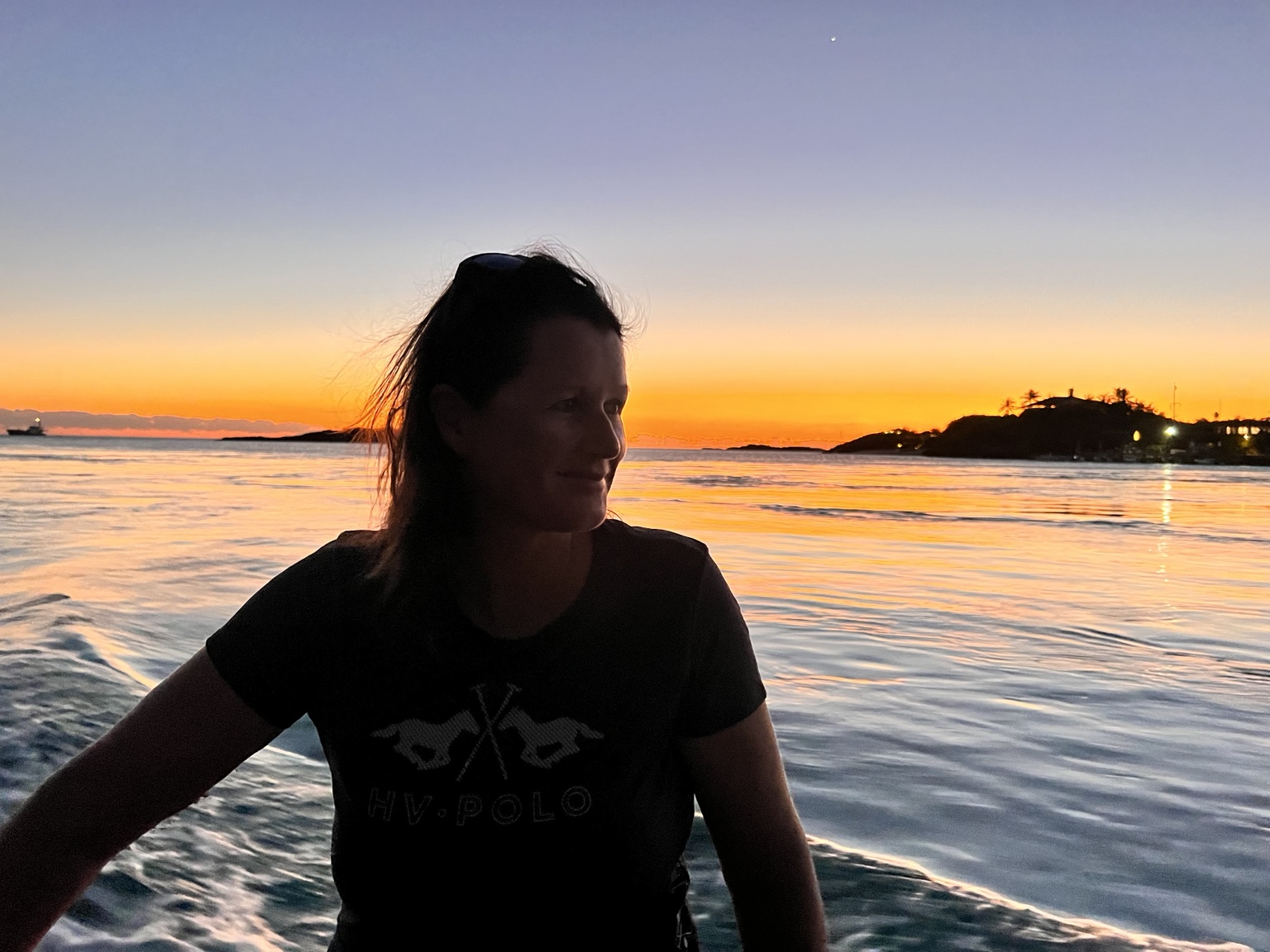
Some questions do not end with the question mark. They keep circling through your mind, touching something you did not even know was asking for attention, until eventually they force you not to search for an easy answer, but to look honestly at yourself.
Recently, Karin Wenger let me read the speech she had written for Discovery Days. Among her words was a question that immediately touched something in me:
How can I dive deep into life without drowning in it?
I read the sentence again.
And then once more.
Perhaps the question struck me because diving, for me, is complicated in both the literal and the figurative sense. I have been sailing across oceans for years now, while my fear of water still plays a part in my life every single day. At the same time, I dive without hesitation into stories, events and the lives of other people. I want to understand what lies beneath the surface, why people do the things they do and which stories are hidden behind what they choose to show the outside world.
I found Karin's question so beautiful and so fundamental that I started wondering how this actually works for me.
How deeply do I dive into life?
Why do I want so badly to know what lies beneath the surface?
And do I always know when it is time to come back up?
Diving deeply into life has never been a conscious choice. It is simply the way I live.
I am not very good at looking just a little, feeling just a little or being only slightly curious. When something touches me, I want to understand it. When someone tells me a story, I do not only hear the words, but also try to discover what is hidden between them. When everything somewhere looks beautiful at first glance, I see that beauty, but at the same time I wonder what stories are unfolding behind closed doors.
Perhaps that is also why travelling, for me, has never been only about tropical beaches, swaying palm trees and our sailing boat anchored in crystal-clear blue water. Of course I see that beauty and enjoy it intensely, but before long I want to know who the people living along those shores are, what occupies their thoughts, what dreams they have, which choices they have had to make and what they have lost along the way.
I do not only want to see that something happens. I want to know why.
I do not only want to hear what someone tells me. I want to understand what they do not say.
I notice that same need when I write. I do not only want to create a beautiful or exciting story, but to descend into the layer beneath it: to the place where people doubt, fear, make mistakes, hold on, let go and sometimes no longer know whom they can trust. I want to understand what makes someone choose a particular path, even when it is a choice I would never make myself.
That is where, beneath the surface, the most interesting stories are often found.
But also the stories that carry the greatest weight.
Because when you dive deep, you do not only find beauty. You also find sadness, injustice, fear, loneliness and questions for which there may never be an answer.
There is another contradiction in me that may sound strange: I am endlessly curious about people, yet at the same time I am also afraid of them.
Not afraid of an ordinary conversation, an encounter or a group of people around me. I can be social, laugh, listen and genuinely enjoy the stories of someone I have only just met. I love doing things together with other people, but preferably when there is someone with me whom I already trust. Someone around whom I do not constantly have to think about what is being said, what is meant and what may have been left unspoken.
Because underneath my curiosity, there is also vigilance.
One part of me knows how beautiful, warm and loyal people can be. Another part has never forgotten how deeply people can hurt one another.
The deepest breach of trust in my life did not come from a stranger. It came from someone who should have offered me unconditional safety. Someone around whom I should never have needed to be on guard and from whom I should have been able to assume that love did not depend on whichever version of the story happened to be most convenient at the time.
When that safety disappeared, something fundamental inside me changed.
I discovered that words can be twisted, that you can be made the guilty one in a story in which you barely recognise yourself and that a bond you believed to be unbreakable can still disappear. Later, there were more people who damaged my trust, treated me cruelly or humiliated me. Each experience added another layer to the previous one and confirmed something I had already started to believe: trust makes you vulnerable, and vulnerability can be used against you.
That is why people have to earn my trust slowly.
At first, I keep them at a distance and watch what they do, not only what they say. I notice how they speak about other people, how they react when something does not go the way they want and whether their words match their behaviour. I want to know whether someone is safe before I reveal parts of myself that could later be used against me.
Sometimes I find that sad.
I wish I could approach people more openly, without there always being a small part of me in the background watching, listening and checking. I wish trust could sometimes simply grow without first having to pass a long series of invisible tests.
But my caution did not appear from nowhere. It was shaped by what I have experienced.
Perhaps I do not need to reject it.
When I thought more deeply about my curiosity about people, I began to wonder whether something else might lie underneath it.
Perhaps I do not dive so deeply into people only because I find them interesting. Perhaps I also try to understand them because I hope that, if I do, they will not be able to surprise me again.
If I listen carefully enough, recognise the patterns in their behaviour and notice when their words do not match what I feel, perhaps I can see the danger before it reaches me. When I understand why someone behaves in a certain way, perhaps they feel less unpredictable. Understanding gives me a sense of control over something that once happened completely beyond my control.
My curiosity has therefore become more than interest. It is also protection.
Perhaps sometimes I try to understand people so completely that there is no unknown depth left from which something unexpected can suddenly rise. As though knowing enough could prevent someone from unexpectedly turning against me, damaging my trust or making me doubt my own perception again.
But no matter how deeply I dive into another person, I will never be able to see everything.
People can change. They can hide things, present themselves differently or reveal a side I never expected. No amount of knowledge can give me the certainty that my trust will never be damaged again.
Perhaps, then, I do not need to learn how to prevent anyone from ever surprising me again.
Perhaps I need to learn to trust that, when it happens, I will not abandon myself again.
That I will take my own feelings seriously when something does not feel right. That I will not endlessly search for explanations for behaviour that hurts me. That I will no longer push my own boundaries aside simply because I want so badly to understand the other person. And that I am allowed to walk away when someone repeatedly shows me that my trust is not safe with them.
My sense of safety does not have to come only from understanding another person.
It may also come from trusting myself.
Perhaps that is also why I am so comfortable spending time on my own.
Being alone does not automatically feel like loneliness to me. Often it is precisely the place where I do not have to watch anything, analyse anyone or wonder what somebody really means. I do not have to adapt, stay alert or explain any part of myself.
And in that space, I discovered something I never expected to love as much as I do: writing.
The ideas just keep coming. One story is not even finished before another begins to appear somewhere in my mind. Characters start interfering with my thoughts, scenes emerge at moments when I am not consciously thinking about them at all and questions that occupy me in real life sometimes find their way out through a story.
Stormy days, in particular, have become wonderful writing days. When the wind howls around My Motu, the rain beats against the windows and the world outside temporarily becomes smaller, I can open another world behind my screen. I can disappear into it for hours. I can organise events, try to understand people and put words to emotions that are much harder to capture in everyday life.
When I write, I decide how deeply I go.
I can descend into painful memories, complicated questions or the darkest sides of a character, but I can also close the document when I feel that it is enough. I can step away, start again or look at an event from another perspective. Perhaps that is why writing gives me something real life does not always offer: the time and space to understand what has happened before I have to respond to it.
Painting does something different for me.
Where writing organises my thoughts, painting quiets my mind. The repetition of the dots, the movement of my hand and the colours slowly coming together into a whole bring me completely into the present moment. I do not have to analyse, solve or explain anything.
Painting is mindfulness for me.
Colours make me happy.
Perhaps writing and painting are therefore more than creative outlets. They are also places where I breathe. Safe spaces where I can go deep without losing myself. Writing gives words to the storm; painting allows the storm to fall silent for a while.
There is another place in my life where that need to understand, to improve and to genuinely make a difference has always played an important role: my work as a dental hygienist.
I have always loved that profession. Not only because I enjoy working with people, but especially because I find it incredibly rewarding to teach someone something that can genuinely change their health. Turning an unhealthy mouth into a healthy one takes time, attention and sometimes a great deal of perseverance, not only from me, but especially from the person sitting in my chair. At first, they may mainly see the treatments that are necessary, the explanations I give and all the things they suddenly need to do differently at home. Often, it is only much later that they truly begin to feel the result.
That moment may be one of the things I love most about my profession.
When someone walks back into my treatment room three months after an intensive period of treatment and sometimes I can already see from their radiant smile that something has changed. Not only in their mouth, but also in their understanding of what health actually means. Only when the inflammation has disappeared, their gums no longer bleed and their mouth feels calm, clean and comfortable do some people realise how much discomfort they had previously come to accept as normal.
And then suddenly I hear: "I had no idea a healthy mouth could feel this good."
That can make me genuinely happy.
Perhaps the same thing that drives me in so many other parts of my life can be found there too. I do not only want to solve something on the surface. I want to understand where the problem comes from, help someone understand it for themselves and then work together towards something that can become genuinely and sustainably better. Not doing the work for someone, but giving them the knowledge and the tools to eventually make the difference themselves.
Perhaps that, too, is a form of diving deep.
Only here, the result looks very different: sometimes it is someone walking into my treatment room three months later, smiling broadly at me and suddenly realising just how good a healthy mouth can feel.
It would make a beautiful story if I could say that I feel safer at sea than I do among people, but that would not be true.
My fear of water plays a role every day. That may sound strange for someone whose home sails across oceans, but fear and adventure do not exclude one another. Sometimes they simply exist side by side.
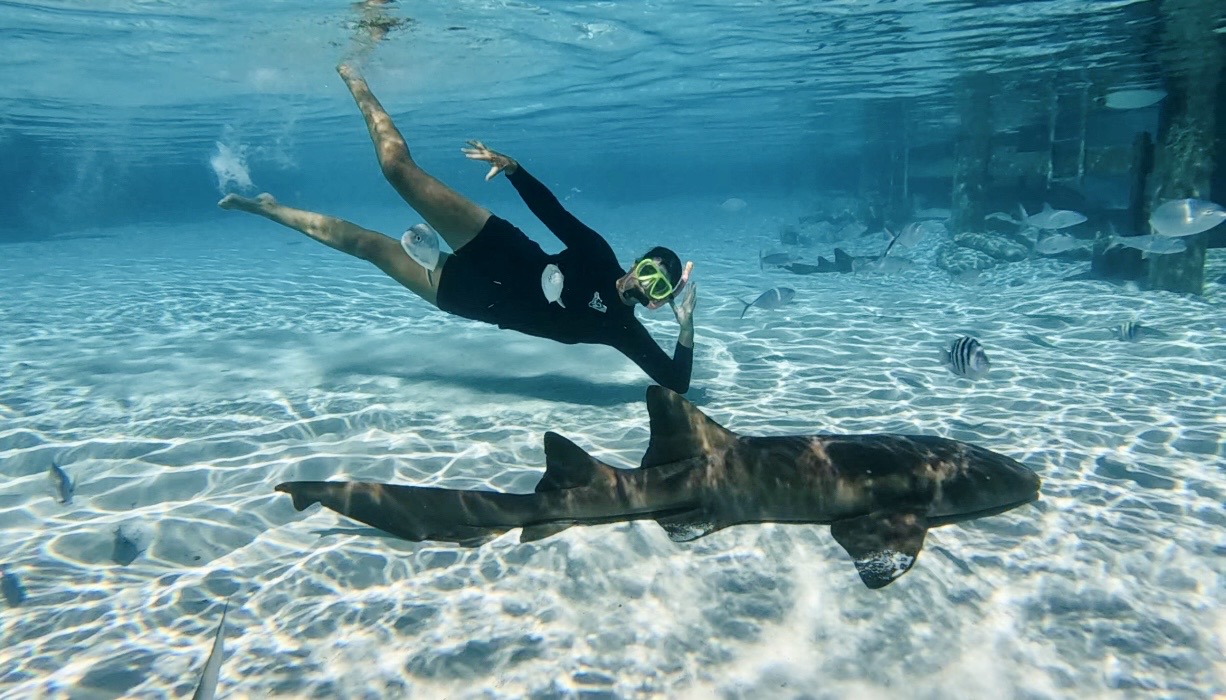
I do not enter the water without fear. I do not blindly trust the depth beneath me, and I do not automatically feel safe simply because the sea looks calm and inviting. The knowledge that there may be kilometres of water beneath me never completely disappears from my thoughts.
And yet I do things that I probably would not dare to do alone.
A large part of that is because of Jeroen.
He does not take my fear away, nor does he pretend that it is nonsense. He knows it is there and supports me without making me feel smaller because of it. His presence allows me to go further than I ever thought possible. Not because he can stop every wave or guarantee that nothing will happen, but because I trust that he will stay beside me when I am afraid.
Perhaps that is the purest form of safety another person can give.
Not promising that nothing will ever go wrong, but making you feel that you will not have to face it alone when it does.
Jeroen is not the only one. My younger sister and her family, my brother and his family, my parents-in-law and my sister-in-law belong to the small circle of people around whom my vigilance can soften. People who know me through and through, who do not simply listen to what is said about me, but trust what they themselves have seen and experienced over all those years.
With them, I do not constantly have to explain who I am.
They know.
Perhaps life has not only taught me that trust can be damaged. It has also shown me that there are people who remain standing when things become complicated. People who do not disappear the moment your truth becomes uncomfortable and who do not ask you to deny yourself in order to preserve the relationship.
They prove that caution and connection can exist side by side.
All my life, I have believed in the words: Giving up does not exist.
That belief has taken me far. It helped me persevere when something seemed impossible, start again when a plan failed and continue at moments when it would have been much easier to turn around. It gave me the courage to leave a familiar life behind, step aboard a sailing boat and cross oceans despite my fear of water.
But even a belief that has carried you for years can become dangerous when you take it too literally.
Because what does not giving up actually mean?
Does it mean I must always continue, even when my body or my thoughts are asking for rest? That I must solve every problem, answer every question and try to understand every person? That I am only strong when I push myself beyond my limits and may only stop when there is truly nothing left?
Perhaps I have too often mistaken stopping, resting and stepping away for giving up.
Perhaps I thought I was only living fully when I was testing my limits, while boundaries are not always there to be broken. Sometimes they are there to protect me.
I have become very good at continuing. At gritting my teeth, adapting to whatever is needed and only much later allowing myself to feel what something has actually done to me. When things become difficult, I usually do not immediately look for the way back. I look for a way forward.
That is a strength.
But sometimes it is also my weakness.
Because when you are used to continuing, you do not always notice that you have not taken a proper breath for a very long time.
How can I dive deep into life without drowning in it?
Perhaps the answer is not to dive less deeply. I do not believe I would be happy if I stayed only at the surface, at a safe distance from everything that might touch me. The depth is part of who I am. That is where my curiosity lives, my involvement and my desire to understand. That is where my stories begin and where I often find the connection I am searching for.
So I do not want to learn to live less intensely.
I want to learn to handle that intensity differently.
By accepting that I do not have to understand everyone completely in order to be safe. By giving people the time to earn my trust without judging myself for being cautious. By not making new people responsible for what others have done to me, but also by no longer opening my heart blindly because I am afraid that otherwise I will become hard or distant.
My caution is allowed to exist.
It carries my history and has helped me remain standing. But I do not want it to become so large that it also closes the door to people who might bring something beautiful into my life.
I do not need to switch off my vigilance.
I only need to make sure it does not make every decision for me.
And when someone does damage my trust, I do not have to keep descending endlessly into that person in an attempt to understand why. Not every pain becomes smaller once I can explain it. Sometimes understanding is not the same as healing, and sometimes stepping away is the most honest answer I can give myself.
Coming back up is not giving up.
A diver does not return to the surface because the depth has defeated them. They come back up because a human being is not made to remain down there forever. They rest, breathe, look around and gather strength before perhaps descending again.
Why should life be any different?
My life has taught me to sail into the waves. Not to retreat when the sea grows higher, the wind strengthens or the horizon temporarily disappears behind a wall of water. I have learned that fear does not always mean you should not do something, and that courage is often nothing more than taking the next step while fear is still walking beside you.
But the ocean is teaching me something else now as well.
Not every wave needs to be fought.
When you resist every movement of the water, you exhaust yourself. Sometimes you have to move with it, relax your body and trust that the same water that washes over you can also bring you back to the surface.
Perhaps the same is true of life.
I do not have to control every current. I do not have to immediately give meaning to every loss. I do not have to understand every person completely, nor do I have to be stronger than I truly feel in every difficult moment.
Sometimes I may write until the words have brought order to the chaos in my mind.
Sometimes I may paint until only the colours remain.
Sometimes I do not have to solve anything.
And sometimes I may trust the people who, over time, have shown me that they will not let me fall.
For someone who has always believed that giving up does not exist, that may be one of the hardest lessons of all: discovering that allowing yourself to be carried has nothing to do with giving up.
Perhaps it takes even more courage than continuing to fight.
The question Karin Wenger asked in her speech has not given me a simple or complete answer. Perhaps such an answer does not exist. Perhaps it changes as we grow older, experience more and repeatedly discover where our boundaries lie.
But her question has shown me something important.
I do not drown because I dive deeply. The depth is not my enemy. It is part of me and makes me who I am.
The danger only begins when I forget that I also have to come back up. When I continue while everything inside me is asking for rest. When I try to carry other people's pain as though it were my own. When I believe I have to understand every person completely in order to protect myself. When I distrust my own feelings because someone else tells a more convincing story.
So perhaps my answer to Karin's question is this:
I can continue to dive deeply into life as long as I give myself permission to come back up as well. As long as I listen to the moment when I am running out of breath, continue to trust my own perception and understand that I do not have to fight every wave or explore every depth completely.
I want to continue feeling deeply, loving, exploring, writing and living. I want to remain fascinated by what lies beneath the surface and not become afraid of questions for which I may never find a simple answer.
I want to remain curious about people, even though I sometimes find them frightening.
I want to be allowed to be cautious without closing myself off completely.
I want to keep trusting, but no longer at the expense of myself.
And when someone does surprise me, I no longer want to believe that it means I should have looked more carefully, dug deeper or understood sooner. Instead, I want to trust that I have the strength to listen to my own feelings, protect my boundaries and return to the people with whom I feel safe.
To the quiet.
To the colours.
To the words.
To the people who truly know me.
To the air above the water.
To the light.
Because truly living deeply does not only require the courage to descend.

It also requires the wisdom to know when it is time to come back up.
MESSAGES ON BOARD
Leave a message
Share a thought, question or greeting. Aagje reads every comment before it appears here.
Loading comments…