
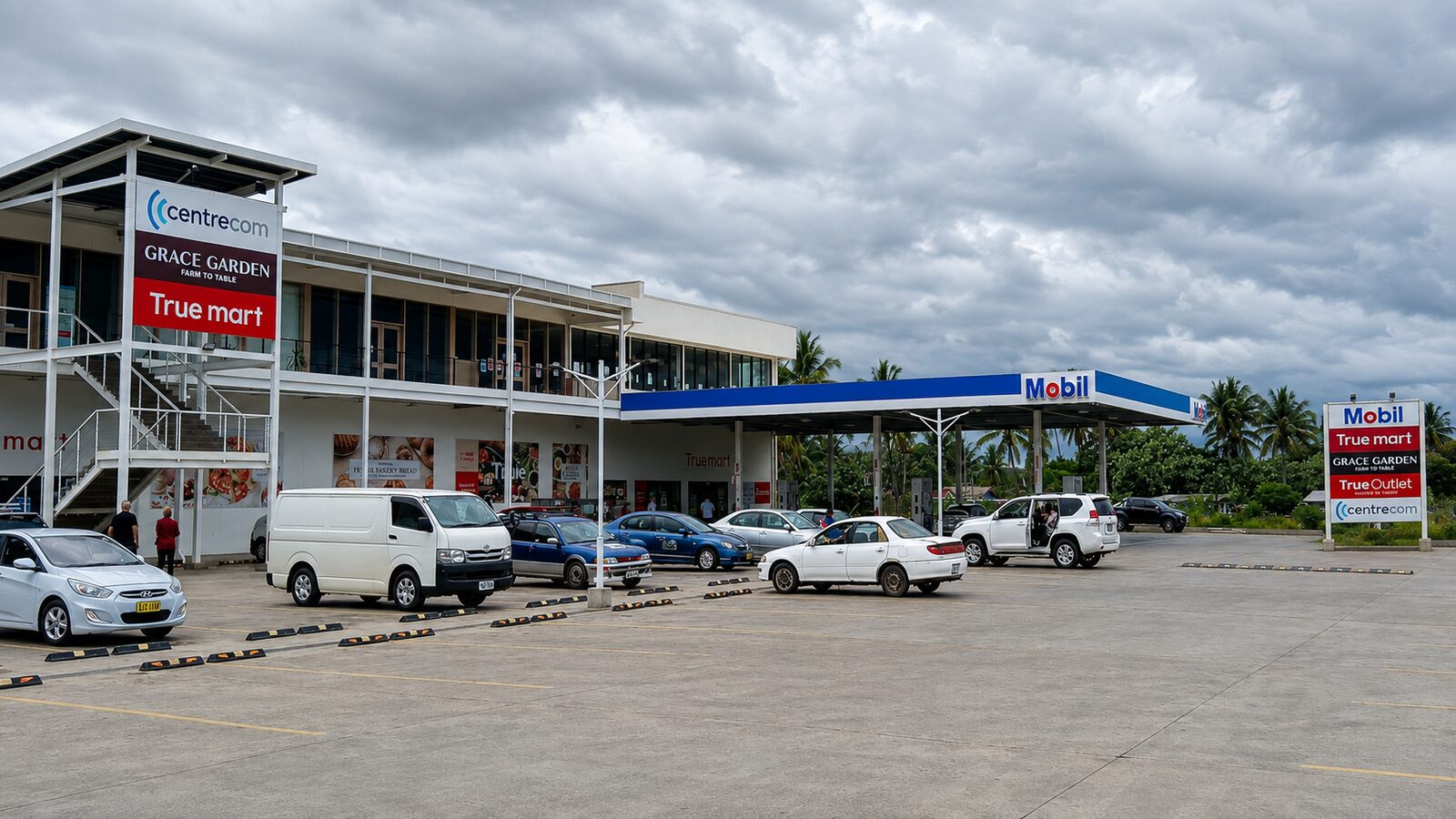
For us, it began with something very ordinary: meat.
When you live on a sailing boat for an extended period of time and regularly leave for islands where there are no supermarkets, shops or even simple markets, you automatically begin to look at provisions differently. A good meat department is no longer merely convenient; it partly determines what you will be able to put on the table during the weeks ahead. Before once again heading off to live off grid for several weeks, we therefore drove to True Mart on the Denarau Bypass Road, close to Nadi. We knew that it had one of the best meat departments in the area and that we could find almost everything we needed in one place.
True Mart was clean, modern and well organised. The products were neatly displayed, the meat looked good and we could fill up with fuel outside at the same time. We had something to drink, ate some food and bought our provisions, just as many other people do every day. As far as we could see, many Fijians worked there, and nothing about the shop, its employees or its atmosphere gave us any reason to suspect that a much larger and considerably darker story was hiding behind this apparently successful business.
We saw a well-organised supermarket.
We saw a petrol station, a café and a place where we could replenish our supplies without having to make several different stops. What we did not see was Grace Road. Of course, the name must have been displayed somewhere and we had probably seen it before, but a name only gains meaning once you know the story behind it. To us, True Mart was simply a practical and reliable place to buy groceries. We had no reason to wonder who owned it, where the money went or who might be paying the real price for the efficiency and quality that we found so convenient as customers.
Then we watched the documentary How a Cult Took Over Fiji by Fern.
From that moment onwards, our innocent bags of groceries suddenly looked very different.
The Promised Land
The story of Grace Road did not begin in Fiji, but in South Korea, where pastor Shin Ok-ju convinced her followers that a worldwide famine and other apocalyptic events were approaching. According to her teachings, Fiji was the promised land appointed by God: a safe place where her followers would survive and from which they would eventually provide food for the rest of the world.
For the people who believed her message completely, moving to Fiji was not an ordinary form of emigration. They left their homes, careers, possessions and familiar surroundings behind because they were convinced that a disaster was approaching outside Fiji from which almost nobody would escape. Around 2014, hundreds of South Korean followers moved to the island nation that most of us associate with white beaches, swaying palm trees and crystal-clear lagoons.
Former members, however, say that the promised land turned into a place from which they could barely escape.
According to their statements, passports were confiscated, families were separated and members were forced to work long hours without having control over their own earnings. Violent rituals took place within the religious community in which people were beaten, supposedly to rid them of evil spirits and sin. Sometimes family members were forced to strike one another while the group and its leaders watched.
One of the women who brought her story to the outside world was Seo-Yeon Lee. She travelled to Fiji with her family in 2014 after her mother joined Grace Road. She did not trust the movement herself, but she did not want to leave her sick mother alone. Once inside the compound, she discovered that her passport had disappeared. When she tried to call the police, she says that other members cancelled her emergency call and disconnected the telephone. Eventually, she managed to run away and happened to encounter police officers who helped her contact the South Korean embassy. She escaped, but left behind her mother and eleven other members of her family.
It is difficult to imagine that something like this could be happening in the same country where we sail freely from island to island, are welcomed into villages, present our sevusevu and repeatedly experience the warmth and hospitality of the Fijian people. Perhaps it is precisely this contrast that makes the story so difficult to absorb. To us, Fiji has become a place that represents freedom. For other people, that same Fiji became a prison.
From Religious Community to Business Empire
While former members came forward with stories of abuse, forced labour and isolation, Grace Road was building something in Fiji that, from the outside, looked mainly like an impressive commercial success.
The organisation established agricultural businesses and then continued to expand. Restaurants, bakeries, cafés, supermarkets, petrol stations, beauty salons and construction companies followed. Grace Road became involved in major projects, was awarded government contracts and grew into a name that became almost impossible to avoid on Viti Levu.
True Mart, where we bought our groceries, is part of that network.
This also explains why the organisation initially received so much appreciation. Grace Road invested in agriculture and food production in a country that depends on imports for many products. Its shops were clean and modern, its restaurants affordable and the organisation provided jobs for local Fijians. After Cyclone Winston, the group also helped with reconstruction efforts. From that perspective, the Fijian government saw a successful foreign investor that brought employment, food production and economic growth.
In 2021, a new True Mart branch near Nadi was officially opened by then Prime Minister Frank Bainimarama. Grace Road received awards and was praised by prominent politicians for its entrepreneurship and its contribution to Fiji.
At the same time, questions remained about how that success had been achieved.
Investigative journalists from the Organized Crime and Corruption Reporting Project and the Korea Center for Investigative Journalism discovered that hundreds of members were registered as shareholders in various Grace Road businesses. Former members, however, said that they did not know how their money was being used, had no control over the companies they supposedly co-owned and, in some cases, had only been listed as shareholders to obtain work permits. According to the investigation, members collectively brought at least twenty million Fijian dollars into the country. Grace Road was also reported to have received millions in loans from the state-backed Fiji Development Bank.
The organisation denies allegations of forced labour, passport confiscation and the detention of members. Grace Road presents its Korean workers not as exploited employees, but as co-owners jointly building a future in Fiji. Daniel Kim, the son of founder Shin Ok-ju and the man who took charge of the group’s operations in Fiji, has also publicly denied several of the allegations.
That response belongs in the story. Not everything alleged about the organisation’s current business operations has been established by a court.
Other parts of the story, however, ceased to be rumours a long time ago.
What the Court Established
In South Korea, Shin Ok-ju was convicted of offences including assault, false imprisonment, fraud and child abuse. During the trials, testimonies and footage emerged of the so-called threshing floor rituals, during which members were beaten and humiliated to drive away sin or evil spirits. Her initial prison sentence was increased to seven years on appeal and upheld by the South Korean Supreme Court in 2020.
Even after her conviction, the businesses in Fiji continued to expand.
In 2023, Fijian authorities attempted to deport several senior Grace Road members after it became clear that they had been wanted by South Korea for years. Two people were deported, while others used legal proceedings to prevent their immediate removal from Fiji. The events once again exposed how complicated the relationship between Grace Road, the Fijian government and the South Korean justice system had become.
And the story is still not over.
Grace Road is explicitly mentioned in the United States Trafficking in Persons Report 2025. The report states that Fijian police opened an investigation into human trafficking allegations involving members of the religious organisation and its businesses. At the beginning of 2026, American women who had escaped from the community said they were prepared to return to Fiji to provide evidence to the police. One of them claimed that she had worked for years without receiving wages and had been required to provide free beauty treatments to influential people.
This does not mean that every employee we saw at True Mart was working under coercion, that every Fijian employed there was being mistreated or that everything Grace Road built in Fiji was achieved solely through exploitation. We must be careful about making such claims. We personally saw nothing that alarmed us at the time. The employees we encountered were simply doing their jobs and many of them were, as far as we could see, Fijian.
But perhaps that is the most disturbing part of the entire story.
You do not see it.
When Exploitation Does Not Look Like Exploitation
When we think of exploitation, we often imagine circumstances that are immediately recognisable: frightened faces, locked gates, guards, dilapidated buildings or people visibly asking for help. We expect something to feel wrong and assume that we, as outsiders, will instinctively notice it.
But what happens when the shop is clean, the coffee tastes good, the meat is neatly packaged and the employee behind the counter smiles politely?
What happens when there are many local Fijians working alongside the Korean employees and there is nothing unusual for a customer to see?
What happens when the company creates jobs, produces food and builds facilities that many local people are happy to use?
Suddenly, the situation becomes far more complicated.
The documentary did not only make us watch the violent footage and listen to the stories of former members with horror. It also forced us to think back to our own visits. To the meat we bought, the fuel we purchased and the food and drinks we paid for without a second thought. Not because we consciously wanted to support a controversial organisation, but because we had no idea.
Now we do know.
And with that knowledge, our responsibility changes as well.
What Is Inside Our Shopping Bags?
Since watching the documentary, I have serious doubts about whether I still want to shop at True Mart, fill up with fuel there or eat at one of the restaurants connected to Grace Road.
At the same time, the honest answer is not as simple as declaring that we will never go there again and that the problem has therefore been solved. Grace Road has become deeply intertwined with the Fijian economy. Its businesses provide jobs for local people, purchase products, possibly pay wages that support Fijian families and offer services used by many residents. If customers stop going there, it might not be the leaders of the organisation who feel the consequences first, but the ordinary employees behind the checkout, in the kitchen and at the petrol station.
Yet continuing to shop there because it is convenient and the meat is good no longer feels the same after everything we now know.
Perhaps there is no completely pure choice available to us. As temporary visitors, we cannot fully understand how all the financial structures operate, which employees are voluntarily involved with the organisation and who might still feel that they are not free to leave. We cannot decide from the deck of our boat what should happen politically or legally in Fiji.
What we can do is refuse to walk through those doors thoughtlessly.
We can ask questions, look for alternatives, support market vendors and independent Fijian businesses and think consciously about where the money we spend ultimately goes. Not because every individual purchase will change the world, but because convenience should never become a reason to stop wanting to know what is happening behind an immaculate façade.
This Is Fiji Too
Some people may feel that a story like this does not belong among our blogs about blue lagoons, welcoming villages, whales, sailing passages and life aboard My Motu. But that is precisely why we want to tell it.
Truly getting to know a country does not mean writing only about its beautiful moments.
It also means looking at stories that do not fit comfortably within the image of a tropical paradise. It means examining the influence of money and politics, the vulnerability of human beings and the way an organisation can make itself almost indispensable before society has fully begun to question what lies behind its success.
Grace Road has not literally taken over Fiji. The country, its culture and its people are infinitely larger and more diverse than one religious movement or business empire. Grace Road has, however, managed to embed itself deeply within Fiji’s daily life and economy in a remarkably short period of time. So deeply that we, without realising it, became customers too.
The next time we drive past True Mart on the Denarau Bypass Road, we will no longer see only the well-stocked meat department, the café and the petrol station.
We will think about the people who left their families and their former lives behind because they believed that Fiji was the promised land.
About those who said their passports were taken away.
About family members who were forced to strike one another in the belief that they were driving out evil.
About people who may have worked for years without having control over their own time, money or future.
And about the uncomfortable truth that the outside of a story can appear so clean, modern and well maintained that nobody thinks to ask what is happening behind closed doors.
At sea, we continually learn how dangerous it can be to look only at the surface. Clear water does not automatically mean there is no reef beneath us, and a peaceful lagoon tells us nothing about the current running through its pass.
Perhaps the same is true of the world on land. Sometimes we have to look deeper before we can truly see where we have arrived.
Sources and further viewing
Fern – How a Cult Took Over Fiji
Al Jazeera – Escaping Korea’s Pacific Cult
ABC News – Seo-Yeon Lee’s story
OCCRP – Investigation into Grace Road and the Fijian Government
U.S. Department of State – Trafficking in Persons Report 2025: Fiji
MESSAGES ON BOARD
Leave a message
Share a thought, question or greeting. Aagje reads every comment before it appears here.
Loading comments…