
After spending quite some time in Naqaiqai Bay, where we had thoroughly enjoyed ourselves and had almost grown accustomed to the bay's peaceful rhythm, our plans suddenly began to move again. Jeroen received a message from Stefan, the owner of another Amel Super Maramu whom we had met several times during our journey.
His waterlock had broken and without it he could no longer start his engine. A waterlock is not exactly something you can pick up from a shelf on a remote island in Fiji, so Stefan had a problem. As luck would have it, we carried a spare one for My Motu.
Jeroen likes to be prepared for anything that might break on our now 36-year-old lady and over the years we have built up quite a collection of spare parts. Some have been sitting untouched in a cupboard or beneath a floorboard for years and, to be honest, there are probably many I do not even know we have on board. Yet moments like this show how valuable it can be to carry a part you hope you will never need yourself.
Stefan was about thirteen nautical miles away, so we decided to sail in his direction the following day. He could temporarily use our spare waterlock and continue towards Lautoka with a working engine, where he would be able to arrange a replacement. We will, of course, get our waterlock back eventually, because it is an important spare for us as well and not something that is readily available everywhere. Even so, we did not have to think about it for long. When someone with the same type of boat is nearby and you happen to have exactly what they need to continue their journey, you help each other.
That remains one of the things I love about the cruising life. We all sail our own routes and make our own plans, but as soon as somebody has a problem, people start looking at how they can help. Sometimes it is with tools, sometimes with knowledge, a few litres of diesel, a spare part or simply two extra pairs of hands.
The next day we raised the anchor and left Naqaiqai Bay for the relatively short sail to Stefan. We had created a good shaded spot for me on deck because I still had to be extremely careful in the sun due to my skin treatment. I was not allowed to expose my skin unnecessarily to the intense sunlight.
Wearing clothes that covered almost everything, with my face fully protected by something that looked more like a ski mask, I probably appeared to be heading into a snowstorm rather than sailing across the tropical waters of Fiji. It was not particularly charming, but by then I no longer cared very much. As long as my skin remained protected and I could spend a little more time outside again, I was perfectly happy.
And I truly enjoyed it.
After spending so much time treating the sun as something I had to hide from, it felt wonderful to sit outside again, feel the wind and watch the water as My Motu quietly continued on her way. When you have been forced to spend most of your time inside for a while, you suddenly realise how much of this life takes place outdoors and how much you miss when you cannot simply be part of it.
At around four o'clock in the afternoon, we reached Stefan and Jeroen climbed into the dinghy with our spare waterlock to deliver it. With the part installed, Stefan could start his engine again and continue towards Lautoka. Instead of hurrying on to another destination, we decided to continue slowly south along the coast of Taveuni.
We had no tight schedule and no definite plan for the days ahead, so we stopped at several anchorages along the way and simply decided from one day to the next what we felt like doing.
Eventually we arrived at the anchorage near Paradise Island, where there is also a resort, and decided to go ashore that evening. Several other cruisers were there and, as so often happens when a group of sailors gets together, a lovely evening developed without anybody having organised a thing.


We started talking, joined some of the others and decided to have something to eat while stories about where everyone had come from, what had happened along the way and where they were heading next naturally made their way around the table. These are the evenings that never appear in any plan, yet often turn out to be the most enjoyable ones.
The following morning we wanted to leave early for Savusavu, while Flora and Lille Venn had said they would come that way later. As soon as we raised the anchor, it became clear that we had been given one of those wonderful sailing days when everything simply feels right.
There were about fifteen knots of wind, nicely on the beam, the sun was shining and My Motu moved beautifully through the water. We arranged my shaded spot once again and while I sat there, fully protected from the sun and listening to an audiobook, Jeroen let out the fishing line behind the boat and kept an eye on the sails and the wind.
It became the kind of passage during which you almost forget how quickly the hours go by. There were no sails that constantly needed changing, no irritating waves arriving from exactly the wrong direction and no wind deciding to do something different every ten minutes. There was simply a boat sailing well, with one nautical mile after another slipping beneath the keel.
Just before we reached the entrance towards Savusavu, the fishing line suddenly started running and we discovered that a bonito had taken our lure. It was not a yellowfin, which we prefer when we want to make sushi, but it was a beautiful bonito that would be delicious cooked for dinner that evening. It is difficult to find anything fresher than a fish that was swimming beside your boat in the Pacific only a few hours earlier.
We did not continue all the way to the busy anchorage in front of Savusavu, but anchored once again near the Cousteau Resort, where we had enjoyed staying before. We were still far too fond of the peace around us to join all the other boats. That evening I prepared a lovely meal with our freshly caught bonito and it did not take long before we both decided that our bed was the perfect place to end such a wonderful sailing day.
We were up early again the following morning. While the sun was still low and less intense, I could be outside reasonably safely, so we decided to use those cooler hours to walk to Savusavu.
It was more than six kilometres from the Cousteau Resort, but after spending so much time on a boat, we love having the chance to really stretch our legs. You move around all day on board, of course, but you can never walk farther than sixteen metres in one direction before the boat simply ends.
We did not need very much because we only intended to stay for a few more days, but I wanted a few important ingredients for baking bread as well as fresh fruit and vegetables from the local market.


I still love those markets. You do not walk through them with a fixed shopping list as you might in a supermarket at home. Instead, you look at what is available that day and decide what you can make with it. Piles of papayas, bananas, cassava, aubergines, tomatoes, herbs and all kinds of other local produce are displayed side by side, and whatever looks best often determines what we will eat over the next few days.


With our bags full, we walked back to My Motu, where we spent two more peaceful days before our friends also arrived in the Savusavu area.
Two days later we watched Flora and Lille Venn sail past. They both had reservations in Nawi Marina and therefore continued straight on, while we stayed in our quiet spot for one more day. We then headed towards town as well. Instead of going into Nawi Marina, we chose a mooring ball just around the corner. We were close enough to visit everyone easily, but could still live aboard My Motu, just as we prefer.
By then, our plans for the following period were slowly becoming clearer. Flora was considering sailing towards Kadavu, while Jeroen, Ralph from Lille Venn and I found ourselves looking more and more often at the weather forecasts for the Lau Group and Fulaga. The idea of returning there became increasingly appealing and, if we did go back, Savusavu would be our last real opportunity to stock My Motu properly for quite some time.
Our shopping list therefore grew considerably.
For two days we bought and carried provisions, worked out which products would keep well and tried to calculate how much we would really need to live off-grid for about six weeks. Long-life products disappeared into the cupboards, our supplies of flour and other bread-making ingredients were replenished, and we took as much fresh fruit and vegetables as possible that we knew would last reasonably well on board. Slowly, My Motu turned into a well-stocked floating pantry.
This remains a very different way of shopping from knowing you can simply return to a supermarket two days later. Among the remote islands of the Lau Group, there is no shop around the corner where we can quickly buy milk, flour or vegetables. You try to imagine what you might need six weeks from now, while knowing at the same time that there will always be something you have forgotten.
Eventually, however, the cupboards were full, the fridge and freezer were packed and we were ready to leave shops, marinas and towns behind for another extended period.
First, we still had a few lovely days together ahead of us. Barbara was leaving for Switzerland for two months and, because we knew we would not see her again for quite some time, we decided to enjoy another four days together. We played games, went out for dinner, spent time aboard each other's boats and, above all, enjoyed being in the same place for a little longer before our routes separated once again.
That may be one of the most remarkable aspects of travelling by sailing boat for years. You meet people somewhere near an island, sail together for a while and then say goodbye because everyone chooses a different direction, only to encounter each other again hundreds of nautical miles farther on. Some boats you see once and never again, while other people keep reappearing throughout your journey and slowly become true friends.
After four days, it was time to wish Barbara a good journey to Switzerland. Flora decided to sail towards Kadavu, while Jeroen, Ralph and I finally turned our attention in the opposite direction.
We were going back to Fulaga.
The weather was not quite cooperating yet, so on a day with very little wind we first returned to Paradise Island. Ralph came that way aboard Lille Venn as well and once again we found ourselves anchored together, this time for two nights, while closely watching the forecasts for our passage to Fulaga.
Waiting two days for better weather is hardly a punishment when you are anchored beside an island like Taveuni, so we decided not to spend all our time looking at the shore from our boats. Together with Ralph, we set out for a drive around the island and visited several unusual places we had not seen during our earlier stops.
One of them was the 180th meridian, marked on Taveuni as the International Date Line. It remains a strange thought that an imaginary line determines the date on which you live and that here, symbolically at least, you can walk from today into yesterday in a few steps and then just as easily return. Nothing really changes, of course. The sun continues to shine, the trees keep moving in the wind and even your watch takes little notice of the step you have just taken. Even so, we could not resist walking backwards and forwards several times. After all, there are not many places in the world where you can step from one day into another in a matter of seconds.
We then continued to a place where thousands of fruit bats, also known as flying foxes, live. We could see dark shapes hanging high in the trees from quite a distance and the longer we looked, the more we discovered. They hung upside down from branches everywhere, sometimes almost motionless with their wings wrapped around them and then suddenly moving noisily when one of them decided to find another place. Every now and then, one took flight and it is only when you see such an animal gliding between the treetops on its enormous wings that you fully understand why they are called flying foxes. There were not merely a few hundred of them, but thousands, making the trees appear almost alive in some places.
Next, we walked beside a river that becomes a natural waterslide when there is enough water. Over time, the flowing water has made the rocks so smooth that, when the water level is high enough, people can slide down the river. Unfortunately, there was not enough water when we visited to try it ourselves, but the walk and the thought of what it must look like after heavy rain still made it a beautiful stop. Perhaps it was just as well that nature had decided to close the slide that day, because we still had one final and far less adventurous mission on our programme.
In Somosomo, we went in search of the ice cream shop. After a day of driving around, stepping backwards and forwards across the Date Line, looking up at thousands of flying foxes and walking beside the river, we had been looking forward to an ice cream. Unfortunately, the shop turned out to be closed at the exact moment we arrived. There we stood, having travelled across the island only to end up in front of a locked door, without ice cream.
There was little we could do except come to terms with our disappointment and drive back to Paradise Island, where My Motu and Lille Venn were waiting peacefully for us. Even without ice cream, it had been a wonderful day. Because we had no strict itinerary and had simply driven around the island together, stopping wherever something caught our attention, we had once again discovered a completely different side of Taveuni.
The following day, a reasonable weather window appeared for Fulaga. It was certainly not perfect, but it looked good enough to make an attempt.
The first ten hours were surprisingly good. We had a lovely wind coming reasonably well from the right direction, My Motu was sailing beautifully and for a while it seemed as though the weather gods were being kinder to us than the forecasts had suggested.
Unfortunately, the wind gradually weakened and moved farther south than we had hoped. It became increasingly difficult to sail our course towards Fulaga and eventually we had little choice but to start the engine.
We had not been motoring for very long when Jeroen and I suddenly spotted a whale. A short time later, the animal remained at the surface less than twenty metres from My Motu.
No matter how many whales we have seen during our journey, the experience never becomes ordinary to me. Every time such an enormous back breaks through the surface and I hear the whale breathe, I feel the same sense of euphoria, as if the rest of the world disappears for a moment and there is nothing but the whale, the ocean and our boat.
We have seen whales leap from the water, watched mothers with their calves and sometimes followed them from a great distance, but when such an enormous animal chooses to remain so close to My Motu, it still feels like a gift. After all, we are merely passing through its world. The whale decides whether to remain at a distance or surface beside us for a while.
All we could do was watch and enjoy the moment until it eventually continued on its way and we resumed our course towards Fulaga.
Meanwhile, the wind continued to fade and because we had absolutely no desire to motor the entire remaining distance, we decided to make an overnight stop at Cicia.
There was supposed to be an anchorage near Takurau Village where we could spend the night. In daylight it would probably have been a fairly straightforward stop, but by the time we reached Cicia it was around ten o'clock at night and completely dark.
We had never been there before, which suddenly made everything considerably more tense.
We could see almost nothing outside and therefore had to rely entirely on our navigation equipment, depth sounder and the satellite images we had studied beforehand to see where the coral was located. The water also remained extremely deep for a long time. We continued towards the anchorage while the depth reading barely changed, knowing from the satellite images that we could not continue indefinitely because the coral began somewhere ahead of us.
At one point, the depth suddenly decreased to about 25 metres and we had to make a decision. We did not want to go much farther, so we lowered the anchor in approximately 23 metres of water. That is already a considerable depth and it means letting out a great deal of chain before there is enough scope to anchor safely.
We lowered the anchor, carefully reversed and waited for it to set, but it did not.
The anchor did not hold properly, so we had no choice but to haul all that chain and the anchor back on board, choose another position and try again. Everything around us remained completely dark and we knew perfectly well that there was coral somewhere ahead, although we could not see any of it.
For our second attempt, we approached from a slightly different direction and lowered the anchor in about twenty metres of water. Once again the chain went out and we carefully reversed. This time, thankfully, we felt the anchor dig in and hold.
After checking for a while that we were truly secure, we could finally relax a little. We did not go straight to bed, however, because Ralph was sailing about an hour behind us aboard Lille Venn and still had to find the same unfamiliar anchorage in the dark.
About an hour later, we saw his navigation lights approaching. Only after Ralph was also safely anchored did Jeroen and I go inside and find our bed.
We would see where we had actually ended up the following morning.
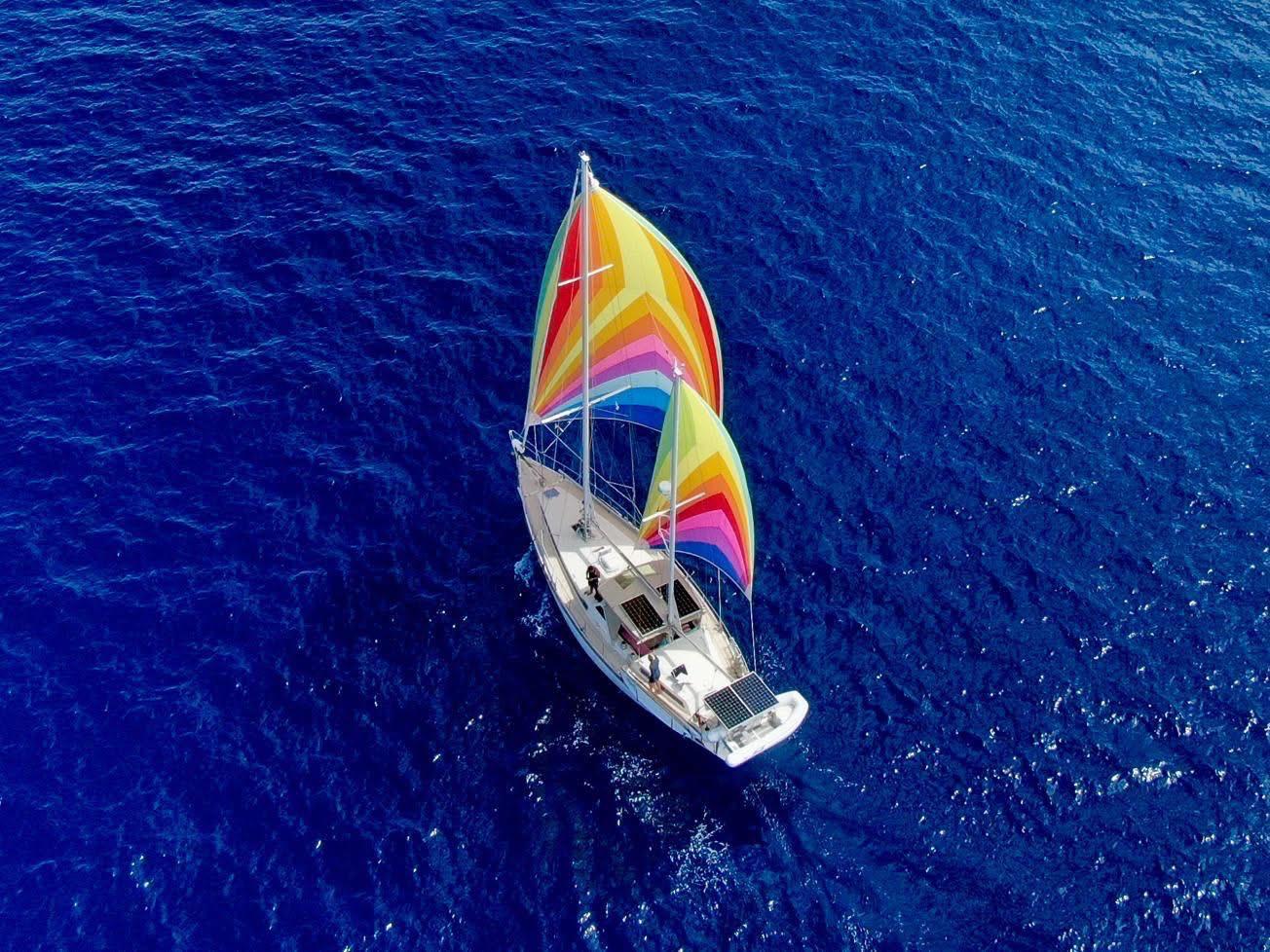
When daylight arrived, the world immediately looked much friendlier and we prepared for the next part of our passage to Fulaga. The conditions were so good that we decided to bring out our two rainbow spinnakers. We cannot use them every day, but it is a magnificent sight whenever both enormous colourful sails are flying in front of My Motu.
In relatively little wind we were sailing at around seven knots and for hours we flew across the water, pulled along by our two rainbows while the engine remained blissfully silent.
For me, these are the moments when sailing could hardly be more beautiful. There is no fighting against the wind, no engine droning for hours and no boat being slowed by unpleasant waves. There is simply our sixteen-metre My Motu gliding almost effortlessly across the water while two enormous colourful sails capture every breath of wind that passes.
We were able to continue like that for almost eight hours before the wind angle changed and we had to lower both spinnakers. The regular sails then took over, allowing us to sail closer to the wind and continue our course towards Fulaga.
It became a wonderful passage and as the night slowly gave way to the early morning, the pass into Fulaga came closer and closer.
At around seven o'clock in the morning, we were directly in front of it.
The sea at the entrance was perfectly calm and we had approximately two knots of current with us, making My Motu almost fly through the pass. After all those hours at sea, it was wonderful to see the landscape of Fulaga appear ahead of us again, with its clear water, rugged little limestone islands and every shade of green and blue that makes this one of the most beautiful places in Fiji for us.
At around eight o'clock we dropped the anchor and found ourselves back in a place we had not expected to revisit quite so soon when we left only a few weeks earlier.
Our timing could hardly have been better because strong winds were forecast from the following day. Normally, that is not necessarily a forecast that makes a sailor happy, but this time we could barely wait. We could finally bring out the wingfoils again.
Paspoort II was also still there with Akky and Helwi, which meant that we had not only returned to a place we had enjoyed enormously before, but had also come back to familiar faces.
After our long, peaceful stay in Naqaiqai Bay, we had returned to Fulaga by a considerable detour. Along the way, we had helped another sailor, explored Taveuni, seen thousands of flying foxes, watched a whale surface less than twenty metres from My Motu, anchored at Cicia in complete darkness and flown across the Pacific for hours beneath two enormous rainbows.
Now we were once again in one of those places whose beauty makes me fall silent every time we arrive. It makes me realise how extraordinary it is that we can move our home across thousands of nautical miles of ocean and then drop its anchor in the middle of a landscape like this.
Sometimes we continue sailing because we are curious about what lies beyond the next horizon, but this time we had mostly longed to return to a place we already knew.
As we looked across the mirror-like water and the small limestone islands around us that morning, it did not feel as though we had gone backwards at all.
It simply felt wonderful to be there again.
MESSAGES ON BOARD
Leave a message
Share a thought, question or greeting. Aagje reads every comment before it appears here.
Loading comments…